

This guide is for importers, distributors and traders buying coated controlled release fertilizer (CRF) in bulk. Garden packs, hobby use, and inhibitor-based stabilised fertilizers are left out, as they sell to different buyers under different rules.
What CRF is in the trade
The US control officials' association, AAPFCO, defines a "slow or controlled release fertilizer" as one "containing a plant nutrient in a form which delays its availability for plant uptake and use after application, or which extends its availability to the plant significantly longer than a reference 'rapidly available nutrient fertilizer'". Trenkel (2010), for IFA, quotes it and notes that, per AAPFCO, "there is no official differentiation between slow-release and controlled-release fertilizers". EN 13266 defines a coated fertilizer as one "encapsulated, by covering it with a water-insoluble material, in order to reduce its release rate in water". Products sell under many brand names; compare core, coating, grade and tested release instead.
Core and coating types
Polymer-coated urea and NPK
Urea, CH4N2O, has a theoretical N content of 46.6% using IUPAC 2021 atomic weights (C 12.011, H 1.008, N 14.007, O 15.999). Coated urea contains less, because the coating adds mass. A producer SDS for polymer-coated urea sold as 44-0-0 (Nutrien, revision 28 January 2026) lists urea at ">94" % with "castor oil, polymer with polymethylenepolyphenylene isocyanate" at 1 to 5 %. For coated NPK, take the grade from the COA.
Sulphur-coated and sulphur/polymer-coated
EU label rules treat these separately. EN 13266 states that "microbial attack on the coating (e.g. sulfur coated fertilizers)" is "not measurable by the technique described".
How release is tested
EN 13266:2001, the CEN method for coated fertilizers, is listed as current by NEN. It covers products releasing nutrients "by a physical mechanism" and excludes pH-dependent hydrolysis and microbial degradation. A 10 g test portion goes into 500 ml of water held at 25 °C, and the nutrient is measured at about ten intervals, the first after 24 h and another at day 28. The test continues until more than 75 % of the nominal water-soluble nutrient has leached, and longevity d75% is the interpolated day at which 75 % is released. Its normative Annex A sets the "slow release" criteria; ask the lab to report against it.
A label line such as "3-4 months" is a longevity claim; ask which method, temperature and release point it rests on. Accelerated methods are allowed "provided they are correlated with this standard", so ask for the correlation.
COA checklist
| Parameter | Why it matters | Where to verify |
|---|---|---|
| Total N, P2O5, K2O as declared | Contract grade | Lot COA |
| Percentage coated by each coating agent | Required on the EU label | COA, label |
| Coating agent identity and content | CMC 9 and REACH status | Supplier declaration, SDS section 3 |
| Release longevity and test temperature | Supports the label claim | EN 13266 report, 25 °C |
| Initial release at 24 h | First EN 13266 test point | EN 13266 report |
| Release at day 28 and at the stated time | Release curve | EN 13266 report |
| Particle size distribution | Matches the tested lot | COA, named sieve method |
| Moisture | Contract basis | COA |
| Biuret, for urea cores | PFC 1(C)(I) limit 12 g/kg dry matter | COA |
| Cd, Cr VI, Hg, Ni, Pb, As, perchlorate | PFC 1(C)(I) limits | Lab report vs 2019/1009 |
| Lot and production date | Traceability for retests | COA, bag label |
EU 2019/1009 rules
Coating polymers fall under CMC 9, which allows polymers whose purpose is "to control the water penetration into nutrient particles and thus the release of nutrients (in which case the polymer is commonly referred to as a 'coating agent')". Point 3 requires plant growth, earthworm and nitrification inhibition tests.
Article 42(6) required the Commission, "By 16 July 2024", to assess biodegradability criteria for these polymers. It adopted Delegated Regulation (EU) 2024/2770 on 15 July 2024. That act replaces CMC 9 point 2: "From 17 October 2028", coating agents must be natural polymers that are not chemically modified, or meet its Appendix 1 criteria. Those criteria require at least 90 % ultimate degradation or mineralisation in soil within 48 months plus the labelled functionality period, and a separate 12-month water test. The original text had set 16 July 2026; recital 9 aligns the new date with REACH. Ask for soil test data under EN ISO 17556:2019 or ASTM D5988-96:2018.
Under Annex III, for coated solid inorganic macronutrient fertilisers "the name of the coating agents and the percentage of fertiliser coated by each coating agent shall be indicated". Polymer-coated products carry "The rate of nutrient releases can vary according to the temperature of the substrate. An adjustment of fertilisation may be necessary". Sulphur and sulphur/polymer coatings add "and the biological activity". Products with a CMC 9 polymer state a "functionality period" (Annex III Part I), and from 17 October 2028 a buffer-zone instruction.
Coated urea or NPK remains PFC 1(C)(I), with its contaminant limits. legislation.gov.uk shows EU text as of 31 December 2020; later acts here come from the Publications Office.
REACH microplastics restriction
Regulation (EU) 2023/2055 added entry 78 to REACH Annex XVII. Paragraph 4(c) excludes "EU fertilising products within the scope of Regulation (EU) 2019/1009", which are covered by CMC 9 instead. For fertilising products outside that Regulation (sold under national rules), paragraph 6(g) applies the restriction "from 17 October 2028". Appendix 15, point 2.1, then requires their coating polymers to meet the 2019/1009 delegated-act criteria. Recital 23 gives the five-year period "for controlled-release fertilisers".
CBAM
CBAM Regulation (EU) 2023/956, Annex I lists CN 3102 and 3105 (except 3105 60 00), so coated urea and NPK imports fall under it.
Packing and bulk handling
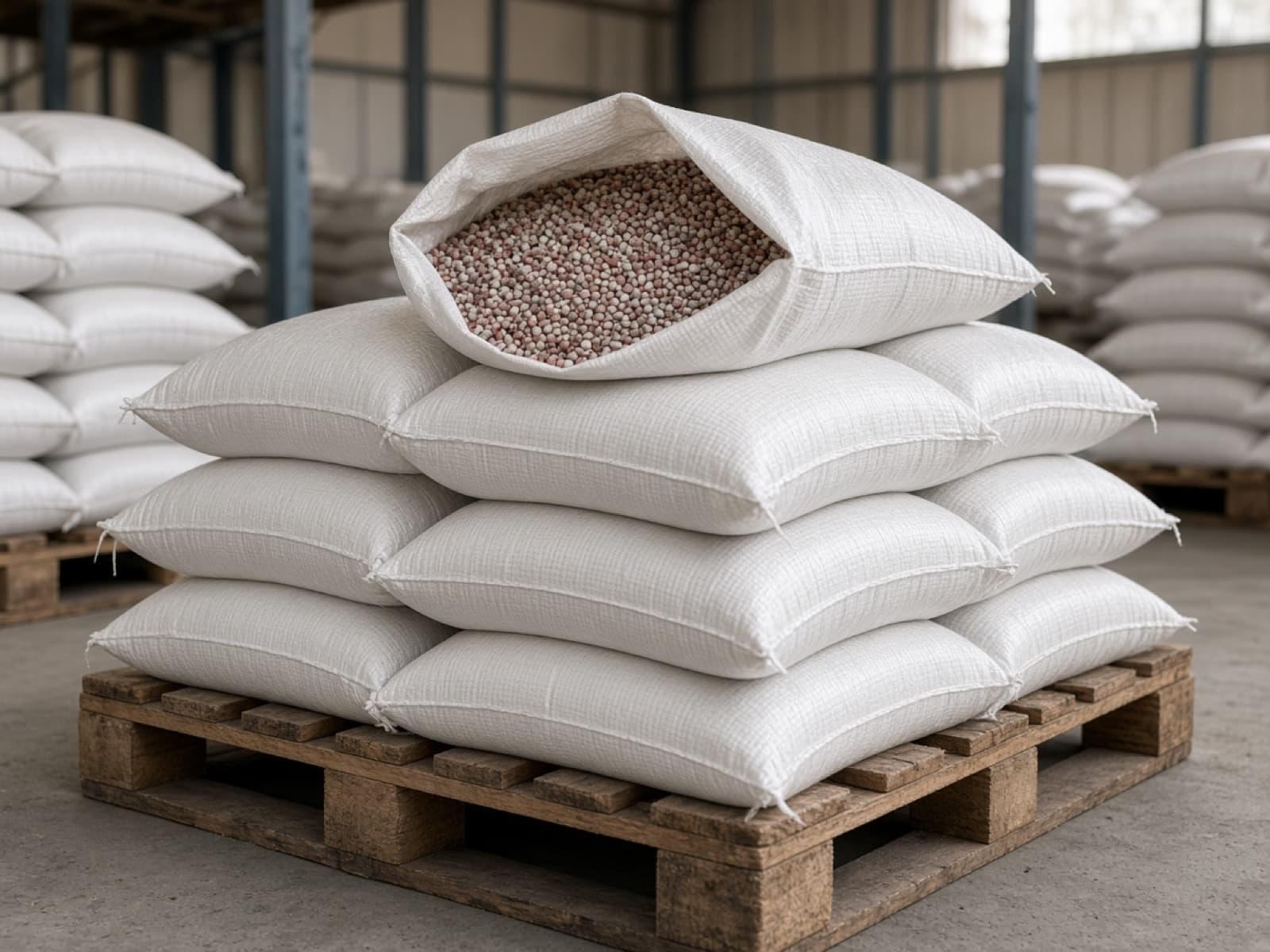
CRF ships in bags and big bags sized in kg, for example 25 kg bags or 500 to 1 000 kg big bags. The Nutrien SDS warns that bulk product "may form steep piles that can collapse without warning" and that the risk rises when it is "loaded or stored when hot or in high humidity conditions". Its section 14 lists the product as "Not regulated" under TDG, DOT, IMDG and IATA. Check section 14 for each cargo, and check classification separately for coated NPK containing ammonium nitrate.
How prices are quoted
Prices are quoted per kg of product under a named ICC Incoterms 2020 rule (EXW, FCA, FOB, CFR, CIF or DAP). Tie the contract to the declared grade, the coated percentage and a release result by a named method and temperature. Agree tolerance and rejection terms, sample approval, and who pays for retests.
Supplier checks before you sign
- Whether the seller is the producer or a trader, and where coating takes place.
- A recent COA plus an independent retest of nutrients and release, by the same method.
- The coating polymer identity, its CMC 9 test data, and its 2024/2770 status.
- For CE-marked product, the EU declaration of conformity.
- A sealed reference sample from loading, for release disputes.
- A named referee lab and method.
FAQ
What is controlled release fertilizer?
A fertilizer with a water-insoluble coating that slows release. AAPFCO covers slow and controlled release in one definition.
How is release longevity measured?
EN 13266 elutes coated fertilizer in water at 25 °C and reports release at 24 h, day 28 and later intervals, with longevity as the day 75 % is released.
What should a CRF COA include?
Grade, coating agent and coated percentage, EN 13266 release data with temperature, particle size, biuret and PFC 1(C)(I) contaminants.
How does the EU regulate polymer coatings?
Through CMC 9 of 2019/1009. Under 2024/2770, from 17 October 2028 coating polymers must be unmodified natural polymers or pass its soil and water biodegradability criteria.
Does the EU microplastics restriction apply to CRF?
CE-marked products are excluded from REACH entry 78. Non-CE fertilising products fall under it from 17 October 2028.
Source controlled release fertilizer
For background, see our older post on slow-release fertilizers, the urea guide and how to test fertilizer quality, or request quotes on GetFertilizer.
Sources
- Trenkel M.E. (2010), Slow- and Controlled-Release and Stabilized Fertilizers, 2nd ed., IFA (quotes AAPFCO Official Publication 57 definition)
- IUPAC, Atomic weights of the elements 2021
- Nutrien (Agrium Canada), polymer coated urea 44-0-0 SDS, revision 28 January 2026 (sections 3, 7, 14)
- EN 13266:2001, preview via iTeh (SIST EN 13266:2002) and NEN catalogue entry
- Regulation (EU) 2019/1009, Annex I Part II, Annex II Part II and Annex III, via legislation.gov.uk (text as of 31 December 2020)
- Commission Delegated Regulation (EU) 2024/2770 of 15 July 2024, Publications Office
- Commission Regulation (EU) 2023/2055, REACH Annex XVII entry 78, Publications Office
- Regulation (EU) 2023/956 (CBAM), Annex I, Publications Office
- ICC Incoterms 2020