

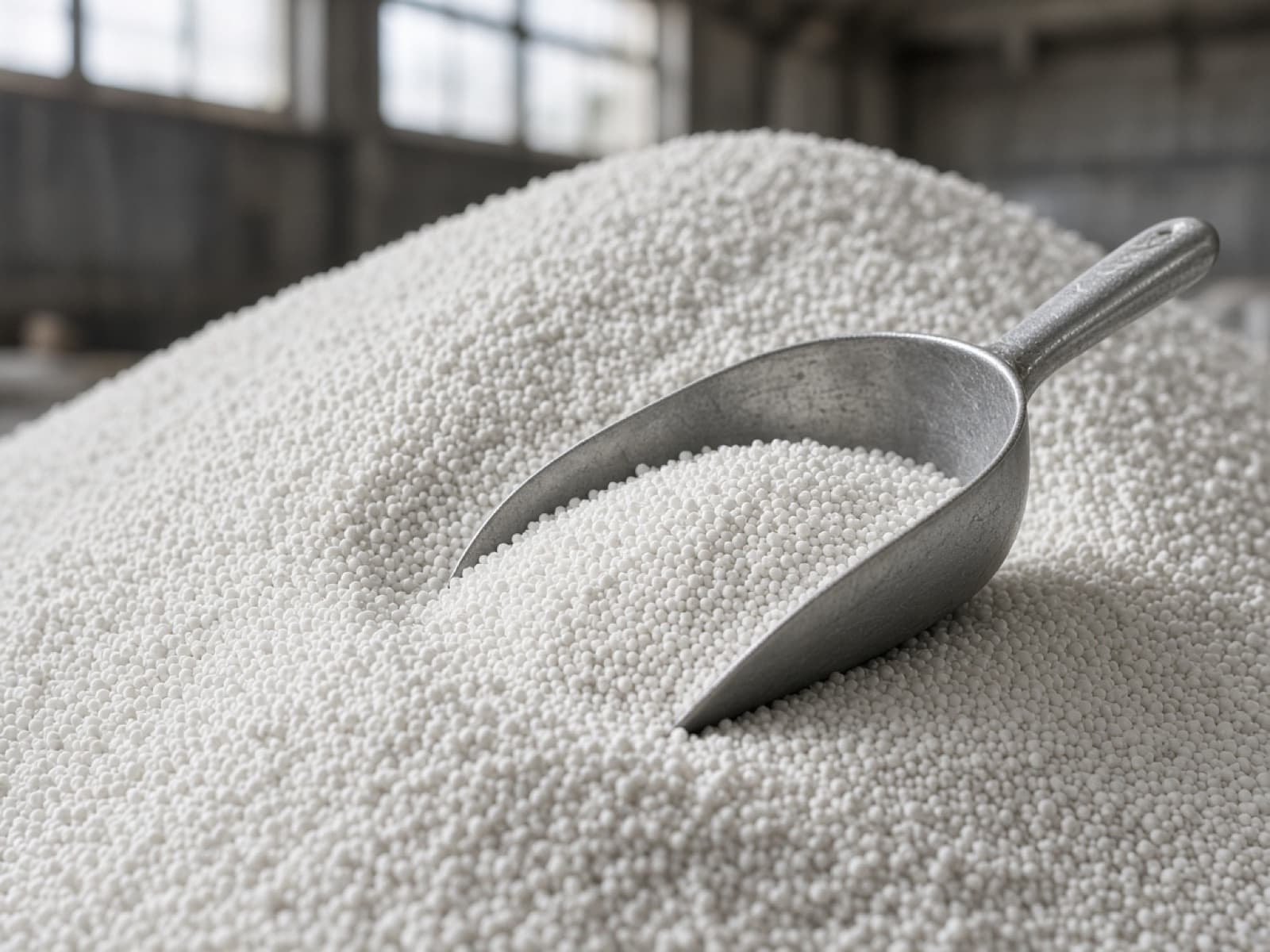
This guide covers anhydrous ammonia traded in bulk as a fertilizer and fertilizer feedstock, for importers, distributors and traders. It does not cover on-farm application, refrigeration-system ammonia, household ammonia or aqueous ammonia (ammonia solution), which follow different specifications, rules and markets.
What it is in the trade
Anhydrous ammonia (NH3, CAS 7664-41-7) is traded as a liquefied gas. Using IUPAC 2021 atomic weights (N 14.007, H 1.008), NH3 has a theoretical nitrogen content of 82.2%. A CF Fertilisers UK Limited SDS (Revision 6, August 2021) gives a boiling point of -33 °C at 1013 hPa.
It is applied directly as a fertilizer mainly in North America, and is the feedstock for downstream nitrogen products including urea, UAN, ammonium nitrate and CAN and ammonium sulphate.
Grades and specifications
A June 2025 PCS Sales (USA) Inc. data-sheet set distinguishes an agricultural grade from refrigeration and metallurgical grades. The agricultural-grade sheet states minima of 99.5 wt% NH3 and 81.8 wt% total nitrogen, moisture of 0.2 to 0.5 wt% H2O, and 5.0 ppm oil maximum. The refrigeration-grade and metallurgical-grade sheets set higher NH3 minima (99.98 wt% and 99.999 wt%) and tighter water and oil maxima; the refrigeration sheet also limits residue and non-condensable gases. Take the contracted grade from the named sheet.
For US MC 330 and MC 331 cargo tanks of quenched and tempered steel, 49 CFR 173.315 (Note 14) sets a minimum water content of 0.2 percent by weight. That is a US cargo-tank rule. Ask the receiving terminal what water content its storage code requires to limit stress corrosion cracking in carbon steel.
COA checklist
| Parameter | Why it matters | Where to verify |
|---|---|---|
| NH3 purity, wt% | Contract grade | Lot COA, named spec |
| Water, wt% or mg/kg | Grade line; some carbon-steel tanks set a minimum | Lot COA, method |
| Oil, mg/kg or ppm as stated | Grade line; confirm the basis | Lot COA, method |
| Other impurities | Residue and non-condensable gases on some sheets | Lot COA, named sheet |
| Loading temperature and pressure | Liquid state for transfer and quantity | Loading report, SDS |
| Quantity method | Shore-tank or ship-tank gauging, with density and temperature correction | Contract, surveyor |
| Lab and surveyor | Custody transfer and COA acceptance | Named lab, appointment |
Refrigerated and pressurised cargo
Refrigerated cargo is carried near atmospheric pressure on large gas carriers built to the IMO IGC Code, and in terminal tanks of that type. Pressurised cargo is carried at ambient temperature on coastal shipments, rail, road and smaller units. The buyer needs a compatible terminal, the required permits, and insurance written for the cargo. Check Sections 7 and 14 of the cargo SDS.
UN 1005 and CLP classification
The UN number is 1005, proper shipping name AMMONIA, ANHYDROUS. An OCI Ammonia Distribution B.V. SDS (31 July 2025) gives Class 2.3 with subsidiary hazard 8 under ADR, IMDG, ADN and RID. A CF Fertilisers UK Limited SDS gives classification code 2TC (ADR, RID and ADN), tunnel restriction code C/D, and IMDG EmS F-C, S-U.
The HSE GB Mandatory Classification and Labelling List entry for ammonia, anhydrous (Index 007-001-00-5, EC 231-635-3, CAS 7664-41-7) is Flam. Gas 2 (H221), Press. Gas, Acute Tox. 3* (H331), Skin Corr. 1B (H314) and Aquatic Acute 1 (H400), signal word Danger, and Note U. The asterisk marks a minimum classification. The CF UK and OCI SDS also add Aquatic Chronic 2 (H411), which is not on that entry. Describe hazards only as the SDS and the list state them. Take Sections 2, 7 and 14 of the cargo SDS, and confirm the transport entry with the carrier and competent authority.
EU storage and import rules
Seveso III (Directive 2012/18/EU) Annex I Part 2 lists anhydrous ammonia (CAS 7664-41-7) as a named substance. The lower-tier and upper-tier qualifying quantities are 50 000 kg and 200 000 kg.
An EU importer exceeding the registration threshold in Regulation (EC) No 1907/2006 Article 6 must register, unless a non-EU manufacturer has appointed an only representative under Article 8. Check the REACH number on the SDS.
Regulation (EU) 2019/1009 PFC 1(C)(I)(b) is a liquid inorganic macronutrient fertiliser that "shall be in liquid form." Annex III requires the label to state whether it is in suspension or in solution. The Regulation, as retrieved, does not define liquid form so as to include or exclude a liquefied gas. Ask the competent authority or a notified body if a cargo can be an EU fertilising product.
Regulation (EU) 2023/956 Annex I lists CN 2814, ammonia, anhydrous or in aqueous solution, in the fertilisers sector. From 1 January 2026, Article 4 requires import by an authorised CBAM declarant. Regulation (EU) 2025/2083 of 8 October 2025 amended 2023/956, including a mass-based exemption below a published threshold. Confirm the current threshold and the declarant duty, and obtain the producer's emissions data.
Regulation (EU) 2025/1227 of 17 June 2025 modifies duties on certain Russian and Belarusian goods, including CN 3102 and specified CN 3105 fertilisers in Annex II, and does not list CN 2814. Council Regulation (EU) 2026/1181 of 22 May 2026 suspends Common Customs Tariff duties and opens tariff quotas, including for CN 2814 10 00 and 2814 20 00, until 31 May 2027. That 2814 suspension does not apply to goods originating in or exported, directly or indirectly, from Russia or Belarus (Article 1(2)). Check TARIC at import.
How prices are quoted
Compare offers on a weight in kg under ICC Incoterms 2020: FOB at the export terminal, CFR or CIF at the import terminal, or DAP or FCA. The price may be fixed, or a formula linked to a published market assessment. Agree laytime and demurrage, a quantity tolerance, and whether settlement uses outturn or bill of lading weight.
Import documents
Include a commercial invoice, bill of lading, certificates of quality, quantity and origin, the SDS in the destination language, the dangerous-goods declaration, and CBAM emissions data from the producer. CN 2814 10 00 is Anhydrous ammonia, under heading 2814 (Commission Implementing Regulation (EU) 2019/1776, Annex I, Chapter 28).
Supplier checks
Confirm whether the seller is the producer or a trader, and whether load and discharge terminals will accept the cargo. Ask for the surveyor's record on similar cargoes and whether the producer can supply CBAM emissions data. Screen origin and counterparties against sanctions, including the 2026/1181 exclusion under CN 2814 10 00.
Low-carbon claims
If a supplier makes a low-carbon claim, ask which certificate scheme it uses and for the emissions data behind the claim, in the form the CBAM declaration will need. Green ammonia and blue ammonia are covered in separate guides.
FAQ
What is anhydrous ammonia fertilizer and what is its nitrogen content?
Anhydrous ammonia is a liquefied gas, NH3, CAS 7664-41-7, traded as a fertilizer and as a fertilizer feedstock. From IUPAC 2021 atomic weights (N 14.007, H 1.008), its theoretical nitrogen content is 82.2%. A June 2025 agricultural-grade sheet states a minimum of 81.8 wt% total nitrogen at a minimum of 99.5 wt% NH3.
What is the difference between refrigerated and pressurised cargo?
Refrigerated cargo is carried near atmospheric pressure on large gas carriers built to the IMO IGC Code, and in terminal tanks of that type. Pressurised cargo is carried at ambient temperature on coastal shipments, rail, road and smaller units. The receiving terminal, permits and insurance must match the mode. Confirm both against the cargo SDS.
How is UN 1005 classified?
The UN number is 1005, proper shipping name AMMONIA, ANHYDROUS. An OCI SDS dated 31 July 2025 gives Class 2.3 with subsidiary hazard 8 under ADR, IMDG, ADN and RID. A CF Fertilisers UK Limited SDS gives ADR classification code 2TC and tunnel restriction code C/D. Take Section 14 of the cargo SDS and confirm it with the carrier.
How are bulk anhydrous ammonia prices quoted?
Offers are compared per kg of product under FOB, CFR, CIF, DAP or FCA, as set out in ICC Incoterms 2020. The price may be fixed or a formula linked to a published assessment. Agree laytime, demurrage, quantity tolerance, and outturn versus bill of lading weight.
Source anhydrous ammonia
To list or request fertilizer-grade anhydrous ammonia, request quotes or browse inorganic fertilizer listings on GetFertilizer.
Sources
- IUPAC 2021 atomic weights: https://iupac.qmul.ac.uk/AtWt/AtWt21.html
- CF Fertilisers UK Limited, Anhydrous Ammonia SDS, Revision 6, August 2021: https://www.cfindustries.com/globalassets/cf-industries/media/documents/safety-data-sheets/ammonia---united-kingdom/anhydrous-ammonia-rev-6-aug-2021.pdf
- OCI Ammonia Distribution B.V., Ammonia, anhydrous, contains less than 0.5% water, SDS ID OC00040, issue date 31 July 2025: https://documentation.oci-global.com/wp-content/uploads/2025/07/OCI-Ammonia-Distribution-Safety-Data-Sheet-Anhydrous-Ammonia-GB-IE.pdf
- PCS Sales (USA) Inc. (a subsidiary of Nutrien Ltd.), Anhydrous Ammonia Agricultural Grade product data sheet, effective 23 June 2025: https://products.nutrien.com/docs/3425
- PCS Sales (USA) Inc., Anhydrous Ammonia Refrigeration Grade product data sheet, effective 23 June 2025: https://products.nutrien.com/docs/3431
- PCS Sales (USA) Inc., Anhydrous Ammonia Metallurgical Grade product data sheet, effective 23 June 2025: https://products.nutrien.com/docs/3433
- 49 CFR 173.315, Note 14 (MC 330/MC 331 quenched and tempered cargo tanks, minimum water content): https://www.law.cornell.edu/cfr/text/49/173.315
- HSE, GB Mandatory Classification and Labelling List, entry 007-001-00-5, ammonia, anhydrous: https://www.hse.gov.uk/chemical-classification/classification/mcl-list.htm
- Directive 2012/18/EU (Seveso III), Annex I, on legislation.gov.uk: https://www.legislation.gov.uk/eudr/2012/18/annex/I
- Regulation (EC) No 1907/2006 (REACH), Articles 6 and 8, on legislation.gov.uk: https://www.legislation.gov.uk/eur/2006/1907/article/6 and https://www.legislation.gov.uk/eur/2006/1907/article/8
- Regulation (EU) 2019/1009, including PFC 1(C)(I)(b) and Annex III, on legislation.gov.uk: https://www.legislation.gov.uk/eur/2019/1009
- Regulation (EU) 2023/956 (CBAM), Publications Office: https://op.europa.eu/en/publication-detail/-/publication/e5587bf5-f383-11ed-a05c-01aa75ed71a1
- Regulation (EU) 2025/2083 of 8 October 2025 amending 2023/956, Publications Office: https://op.europa.eu/en/publication-detail/-/publication/9e9e9b38-aaf1-11f0-89c6-01aa75ed71a1
- Regulation (EU) 2025/1227 of 17 June 2025, Publications Office: https://op.europa.eu/en/publication-detail/-/publication/d7de646f-4d6f-11f0-a9d0-01aa75ed71a1
- Council Regulation (EU) 2026/1181 of 22 May 2026, Publications Office: https://op.europa.eu/en/publication-detail/-/publication/bcd13d58-5af6-11f1-aa6d-01aa75ed71a1
- Commission Implementing Regulation (EU) 2019/1776, Annex I, Chapter 28 (CN 2814 10 00), on legislation.gov.uk: https://www.legislation.gov.uk/eur/2019/1776/annex/I/chapter/28/adopted
- IMO IGC Code (International Code of the Construction and Equipment of Ships Carrying Liquefied Gases in Bulk)
- ICC Incoterms 2020: https://iccwbo.org/business-solutions/incoterms-rules/incoterms-2020/