

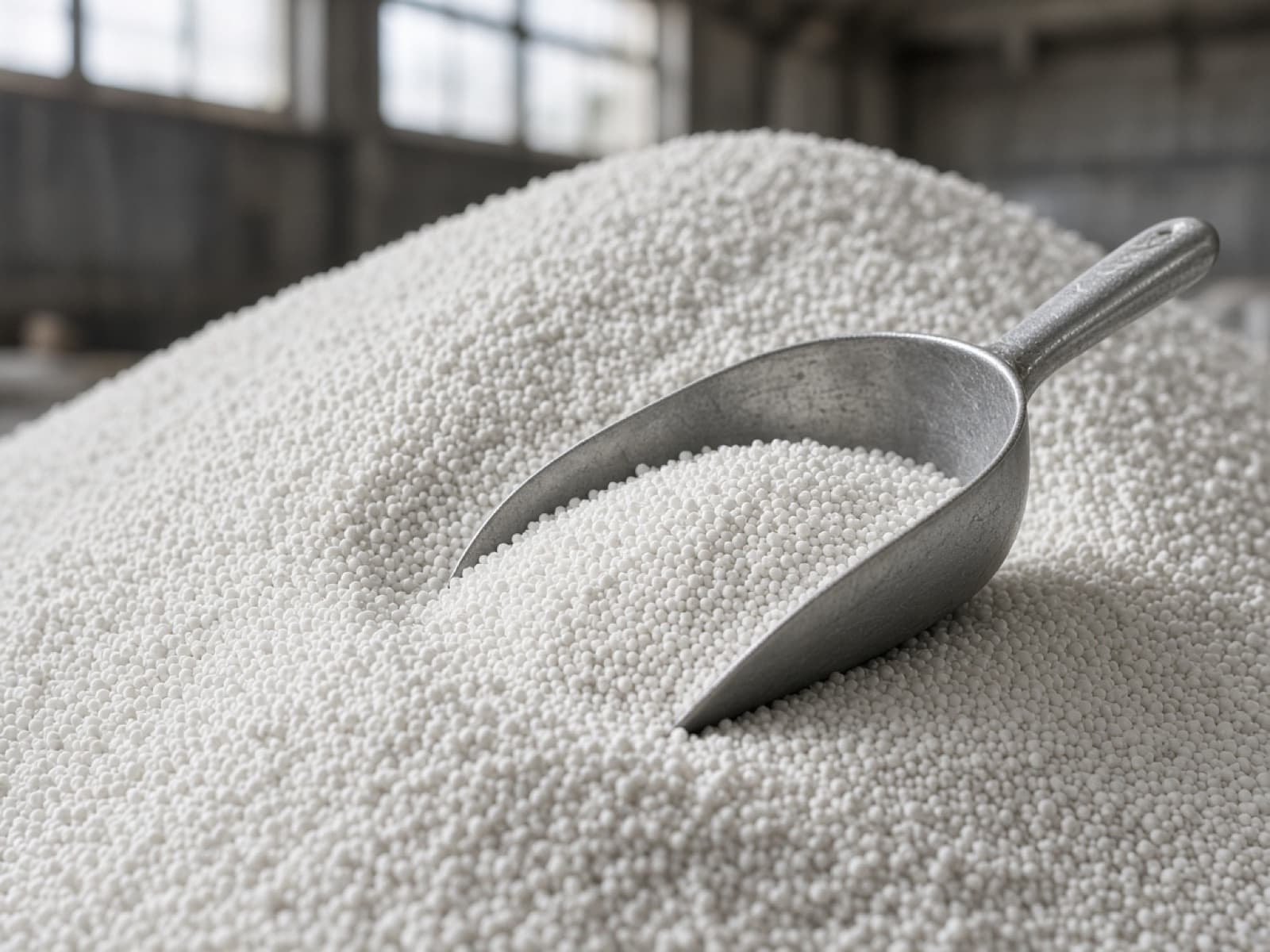
Ammonium nitrate (AN) and calcium ammonium nitrate (CAN) are nitrate-based nitrogen fertilizers. Both sell well in markets where growers want nitrogen that works fast in cool soil and loses less to volatilization than urea. They are also the most heavily regulated straight fertilizers in trade. AN is an oxidizer, it can be misused as an explosive precursor, and it has been involved in serious industrial accidents. Buying it in bulk therefore means more paperwork and more checks than buying urea or potash.
This guide is for importers, distributors, and traders. It covers how AN and CAN differ, which specs to write into the contract, what the compliance side looks like, how prices are usually quoted, and what to verify about a supplier. Incoterms, letters of credit, and pre-shipment inspection work the same way as for other bulk fertilizers, and our earlier guides on bulk urea, NPK, DAP/MAP, and potash go through them in detail.
AN vs CAN
Ammonium nitrate
Fertilizer-grade AN is usually sold as 34-0-0, with total nitrogen guaranteed at around 33.5 to 34.5%. Half of that nitrogen is in ammonium form and half in nitrate form, which is what agronomists like about it. It is made by neutralizing nitric acid with ammonia and then prilling or granulating the melt.
AN absorbs moisture easily and cakes if it is stored badly. Producers coat it and add stabilizers to keep it free-flowing and to limit the breakdown of prills when the temperature swings around 32 °C, where the crystal structure changes. If your warehouse runs hot in summer, ask the supplier how the product is stabilized and what they guarantee on hardness after storage.
Calcium ammonium nitrate
CAN is AN mixed with a calcium or calcium-magnesium carbonate filler, usually ground limestone or dolomite. The most common grade is 27% N, and some producers sell 26% N or other variants with added magnesium or sulfur. The filler lowers the nitrogen content, reduces the acidifying effect on soil, and makes the product much harder to misuse. That is why several countries restrict or ban straight AN and allow CAN.
CAN costs less per kg than AN and more per unit of nitrogen. The premium pays for easier handling, lighter regulation in many markets, and the calcium.
Which one to buy
The decision is usually made for you by the destination country. Check three things before you ask for quotes:
- Whether straight AN is allowed for import and sale in the destination market at all, and under what licence.
- Whether there is a nitrogen threshold above which stricter rules apply. In the EU, for example, high-nitrogen AN fertilizers must pass a detonation resistance test, and sales of AN above a set nitrogen content to the general public are restricted.
- What your own customers can legally receive and store. A distributor selling to licensed farm co-ops can often handle AN; one selling into smaller retail channels may only be able to move CAN.
If any of these answers are unclear, get them in writing from the regulator or a local customs broker before you commit to a cargo.
Specs to put in your AN or CAN RFQ
State the guarantee and the test method for each line. For AN and CAN the usual list is:
- Total nitrogen, with the split between ammonium and nitrate nitrogen.
- Moisture, as a maximum.
- Particle size distribution, for example the share of material between 2 and 4 mm, plus a cap on fines.
- Crushing strength of the granules or prills.
- Combustible or organic material, as a maximum. This matters a lot for AN because organic contamination raises the safety risk.
- Chloride content, as a maximum.
- pH of a solution, and the stabilizer or coating used.
- For CAN, the type of filler (limestone or dolomite) and, where relevant, the calcium and magnesium content.
- For high-nitrogen AN going into the EU or another market with a similar rule, a valid detonation resistance test certificate for the production batch.
Name the laboratory method you will accept for each figure, and say whose inspection report is final: the load port surveyor, the discharge port surveyor, or an umpire lab. Disputes on AN tend to be about moisture and caking on arrival, so agree in advance how a caked or degraded cargo will be measured and priced.
Transport, storage, and permits
AN-based fertilizers are dangerous goods at sea. Most are shipped as oxidizing substances (IMDG Class 5.1), and the exact UN number depends on the composition. Your supplier's safety data sheet should state the classification, and your carrier will confirm it. Some CAN grades with a low AN content may fall outside the hazardous classes, but do not assume this. Ask for the classification in writing.
Expect these to come up during the deal:
- An import licence or permit for AN, often issued by an interior, defence, or mines ministry rather than the agriculture ministry.
- End-user statements or certificates naming who will receive and use the product.
- Port and terminal restrictions on how much AN can be stored, for how long, and next to which other cargo. Some ports will only allow direct discharge to trucks or rail with no stay on the quay.
- Security requirements for storage: locked and monitored warehouses, stock records, and reporting of losses.
- Separation from combustibles, fuels, acids, and urea in the warehouse.
Packaging matters more than with most fertilizers. AN and CAN move in bulk vessels, but many importers prefer 50 kg bags or 500 to 1,000 kg big bags with liners because they protect the product from moisture and make stock control easier for security audits. If you take bulk, check that your discharge port and your warehouse can handle it under the local rules.
How AN and CAN prices are quoted
International AN and CAN prices are usually quoted in US dollars or euros on a weight basis, FOB at the load port or CFR/CIF at the destination port. Bagged product carries a premium over bulk. Price reporting agencies publish regular assessments for the main export and import regions, and many term contracts are linked to one of those assessments with a fixed premium or discount.
When you compare offers, convert them to a cost per unit of nitrogen delivered to your warehouse. A CAN offer can look cheap per kg next to AN and still cost more per kilogram of nitrogen once freight and the lower nutrient content are counted. Add the costs that only apply to AN: permits, security escorts if required, extra insurance for dangerous goods, and any port storage limits that force faster trucking.
Nitrogen fertilizer prices follow natural gas costs and urea markets closely, so watch both when you plan purchases. Seasonal demand in Europe peaks in late winter and spring, which tends to pull CAN and AN prices up ahead of that window.
Supplier checks before you sign
Supplier checks for AN go further than for other fertilizers. Before you sign:
- Confirm the producer's identity and plant. Ask for the producer name on the certificate of origin and the quality certificate, and check that it matches the plant you were offered. Traders sometimes resell product from several sources.
- Ask for recent batch analysis reports and, for EU-bound high-nitrogen AN, the detonation resistance test certificate.
- Ask for the safety data sheet in the language required at destination, and check the stated classification.
- Check that the supplier holds the export licence or permit their own country requires for AN, and ask how long it takes to issue.
- Ask for references from buyers in markets with rules similar to yours.
- Be careful with offers far below the market or with sellers who are vague about origin, permits, or the end user.
On a marketplace like GetFertilizer, you can request quotes from several verified suppliers and compare their specs, packaging, and delivery terms side by side before you go deeper with one of them.
A short checklist
Before you issue a purchase order for bulk ammonium nitrate or CAN, you should have:
- Written confirmation that the product and grade can be imported and sold to your customers.
- An RFQ with guaranteed specs, test methods, and an agreed inspection and dispute process.
- The safety data sheet, the transport classification, and confirmation from the carrier and the discharge port.
- Import permits and end-user documents started early, since they often take longer than the commercial negotiation.
- A landed cost per unit of nitrogen that includes the compliance costs.
- A supplier whose plant, licences, and quality documents you have checked yourself.
Once the permits and the classification are settled, the rest of the deal works much like any other bulk nitrogen purchase.