

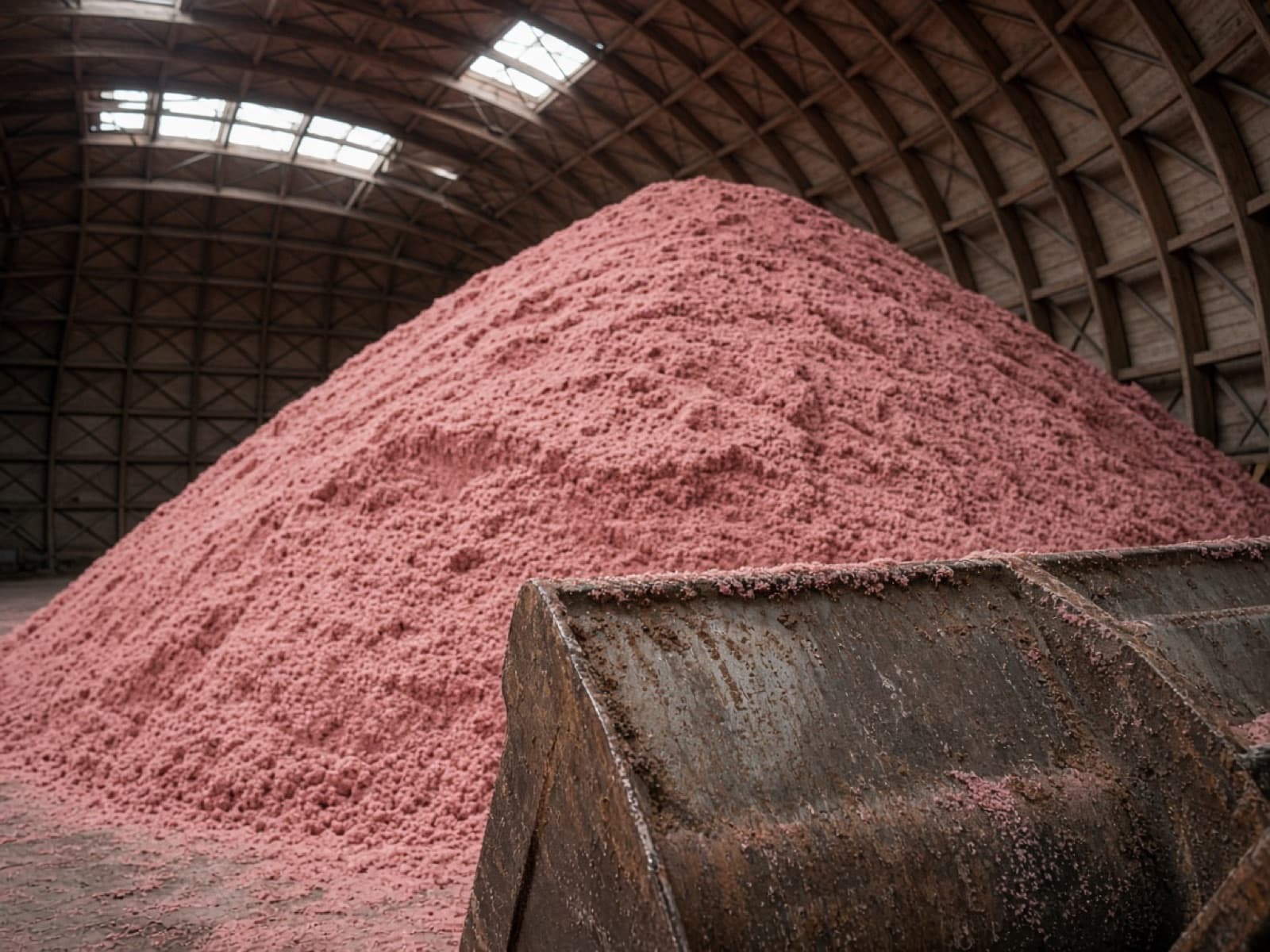
Potash is the trade name for fertilizers that supply potassium, and most of it moves as muriate of potash (MOP), which is potassium chloride. Sulfate of potash (SOP) is the second product, smaller in volume and priced higher. This guide is for importers, distributors, blenders, and traders buying bulk potash fertilizer by the vessel, in big bags, or in containers. It covers how the grades differ, which specs to write into the contract, how potash prices are quoted, and what to check before you sign with a supplier.
Our earlier guides on bulk urea, NPK, and DAP/MAP cover the shared mechanics: Incoterms, letters of credit, and pre-shipment inspection. Here we only cover what is specific to potash.
MOP vs SOP
Muriate of potash (MOP)
MOP is potassium chloride mined from underground deposits or recovered from brines. Pure KCl contains about 63% K2O equivalent, so commercial MOP is usually sold as 0-0-60, meaning a minimum of 60% K2O. Some producers also offer 0-0-62.
MOP is red, pink, or white depending on the deposit and the process. Red and pink product gets its color from traces of iron oxide. Color says little about potassium content, but some buyers, especially those making soluble blends, insist on white. If yours do, write it into the contract.
Sulfate of potash (SOP)
SOP is potassium sulfate, usually sold as 0-0-50 with around 17 to 18% sulfur. Growers of chloride-sensitive crops buy it, and so do blenders who need potassium without the chloride. It is made either from natural brines and minerals or by reacting MOP with sulfuric acid (the Mannheim process). It costs more per kg than MOP, and also per unit of K2O.
Don't take an SOP offer at face value without asking how it was made. Mannheim product can carry residual acidity and higher chloride than SOP from natural sources. Make the supplier state a maximum chloride figure.
Physical grades of MOP
Within MOP, physical form matters as much as the nutrient analysis:
- Granular MOP is compacted product and the usual choice for bulk blending and mechanical spreading. Trade specs commonly quote most of the material between 2 and 4 mm.
- Standard MOP has finer particles. Plants making compound NPK through granulation often use it, and it is also used for direct application in some markets.
- Fine and soluble grades are made for fertigation, liquid fertilizers, and industrial uses. They have tight limits on insolubles.
These grades are priced differently and cannot be swapped for one another. If you supply blenders, match granular MOP to the size of the urea and DAP or MAP they already use. When sizes differ, the blend separates in storage and in spreaders, and the finished product stops matching its label.
Specs to put in your bulk potash RFQ
Most potash claims are about physical quality and how K2O was measured. State minimum or maximum values for:
- K2O content (min), and the test method
- Moisture (max)
- Particle size distribution, for example the share between 2 and 4 mm for granular
- Crushing strength, if the product goes through blending plants or long conveyor runs
- Dust and fines
- Anti-caking agent, and whether it is included in the price
- Insolubles (max), for soluble grades
- Chloride (max) and sulfur (min), for SOP
- Color, only if your customers will reject product on it
Potash can cake when it picks up moisture during storage or shipping. Granules that are too soft break up during discharge and turn into fines. Either problem ends up as a weight or quality claim, so don't accept "seller's standard" for physical specs.
How bulk potash prices are quoted
Potash is priced on a weight basis, per unit of product, normally FOB at the loading port or CFR at the destination port. For granular MOP in particular, prices are often quoted for a specific port region, such as Brazil CFR or Southeast Asia CFR. Price reporting agencies publish regular assessments for the main markets. The World Bank's monthly commodity price data includes potassium chloride, which is a free public source for longer-term trends.
The potash market is concentrated. A handful of countries and producers supply most of the world's MOP. China and India have often bought through annual or periodic supply contracts, and traders watch those settlements as reference points for the rest of the market. A big contract can shift spot pricing in other regions within weeks.
When you compare offers:
- Put every offer on the same basis (FOB plus your own freight, or CFR) before comparing
- Make sure the offers are for the same grade. A standard MOP price is not comparable with a granular one
- Check whether bagging, anti-caking treatment, and inspection are included
- Compare SOP against MOP on cost per unit of K2O, and decide separately whether the sulfur and low chloride are worth the premium to your buyers
- Note the offer validity, which tends to be short when the market is moving
Sanctions and origin checks
Origin matters more for potash than for most fertilizers. Some major producing countries, including Belarus and Russia, have been subject to EU, UK, US, or other sanctions or trade measures at various times, and these rules have changed more than once. Some measures target named producers or logistics routes instead of the product itself.
Before you rely on an offer, confirm the producing plant and country of origin. Then check current sanctions lists and import rules for both the origin and your destination. Ask about the loading port and any transshipment points too. A cargo routed through a third country does not change its origin, and banks handling your letter of credit will usually screen for this. If you are unsure, get advice from trade counsel before you commit.
Logistics and handling
Large importers take potash as loose bulk by vessel. Smaller buyers usually take FIBC big bags or bagged lots in containers. For bulk cargo, ask the shipper how the product is described and declared under the IMSBC Code, and confirm that holds are clean and dry before loading.
Rain during loading or discharge is a common cause of caking, so agree in the sales or charter terms how weather stoppages will be handled. Covered storage at the destination port also matters. Potash left exposed in humid conditions can harden into lumps that need crushing before it can be blended.
Supplier checks specific to potash
The usual checks still apply: capacity, export references, payment terms, and sanctions screening. For potash, also ask:
- Is the seller the producer, an official marketing company, or a trader? If a trader, which mine or plant supplies the product?
- Which grade and color can they supply consistently, and from which plant?
- Can they provide certificates of analysis from past shipments of the same grade, with particle size data?
- For SOP: how is it made, and what chloride and sulfur levels do recent lots show?
- Is anti-caking treatment applied at the plant or at the port?
- Are there export licenses, quotas, or logistics limits at origin that could delay loading?
Producer marketing arms and large distributors control much of the MOP volume. If a trader offers potash well below the market and cannot name the producing plant, insist on independent inspection at loading and check the documents carefully.
RFQ checklist for potash
Send the same fields to every supplier so you can compare the replies:
- Product and grade: MOP 0-0-60, MOP 0-0-62, or SOP 0-0-50
- Physical grade: granular, standard, fine, or soluble
- Color, if it is a commercial requirement
- Quantity (kg), with tolerance
- Nutrient specs: K2O min with test method, plus chloride max and sulfur min for SOP
- Physical specs: moisture max, particle size range, crushing strength, dust
- Anti-caking treatment
- Packaging: bulk, FIBC size, or bag size and material
- Incoterm with named port, and delivery window
- Inspection: who nominates and pays, sampling point, and scope
- Documents: certificate of analysis, certificate of origin, safety data sheet, bill of lading type, and any registration papers your destination requires
- Producing plant and country of origin
- Payment terms and currency
- Offer validity
Set aside any reply that leaves out the producing plant, origin, or test method. Without those you have little to work with if the cargo is disputed or held up at the bank or at customs.
On GetFertilizer you can send one structured request to several potash suppliers at once. Settle the grade, the particle size, and the origin requirements before you send it, so every price that comes back is on the same basis.