

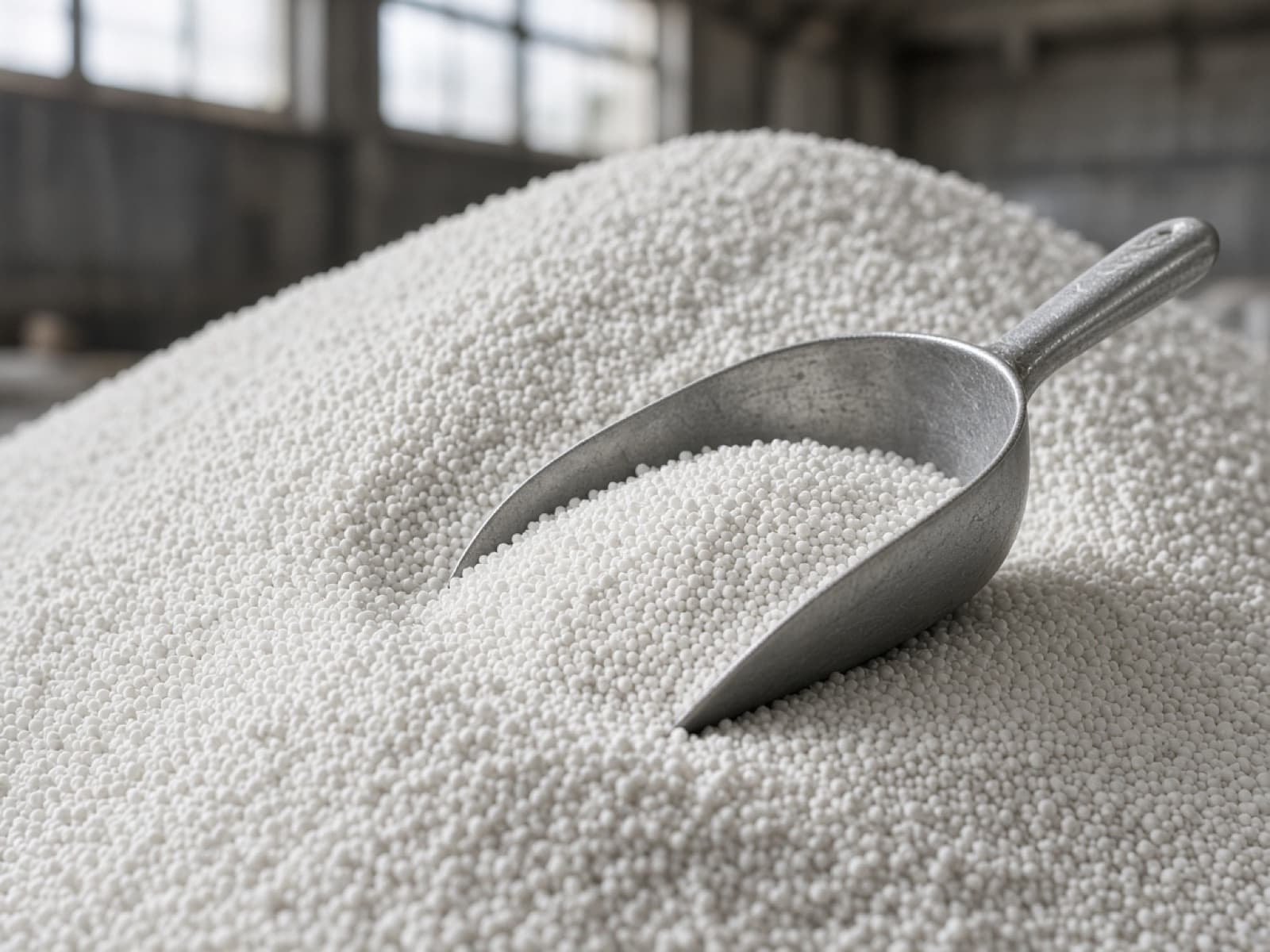
Ammonium sulfate (AS, also spelled ammonium sulphate) supplies nitrogen and sulfur in one product. The standard fertilizer grade carries about 21% nitrogen in ammonium form and about 24% sulfur in sulfate form, often written as 21-0-0-24S. Buyers take it for crops that need sulfur, for soils where an acidifying nitrogen source is useful, and as a sulfur carrier in NPK blends.
AS is easier to trade than ammonium nitrate: it is not an oxidizer and does not carry the security rules that come with AN. It has other complications. Much of the world's supply is a by-product of other industries, quality varies more than with urea, and the granular and crystalline forms behave like two different products. This guide is for importers, distributors, blenders, and traders. It covers the grades, the specs to put in an RFQ, how prices are quoted, and what to check about a supplier. Incoterms, letters of credit, and inspection work the same as in our guides to bulk urea, NPK, DAP/MAP, potash, and AN/CAN.
Where ammonium sulfate comes from
The origin of an AS cargo affects its quality, so ask about it early. Three routes are common:
- Caprolactam by-product: making caprolactam, the raw material for nylon 6, produces large volumes of AS. This is a major source of internationally traded product.
- Coke-oven by-product: steel plants recover ammonia from coke-oven gas and turn it into AS. This material is often darker and can contain more impurities.
- Synthetic and other routes: some plants react ammonia with sulfuric acid directly, and some AS is recovered from other chemical processes and gas scrubbing.
Plenty of by-product AS meets tight specs. Because the producer's main business is something else, AS output follows nylon or steel demand rather than fertilizer demand, and the impurity profile depends on the main process. Ask which route the cargo comes from and set your limits with that in mind.
Standard (crystalline) vs granular AS
Standard or crystalline grade
Standard AS is a fine crystal, usually white to off-white. It costs less and works for direct application, for dissolving in some liquid products, and for compound fertilizer plants that granulate their own NPK. It is a poor fit for bulk blending: the small crystals separate from granular urea, DAP, or MOP in a blend and can cake in storage.
Granular grade
Granular AS is screened or compacted to a particle size close to the other granular fertilizers, so it stays mixed in a blend and spreads more evenly. Blenders and distributors who sell into bulk-blend markets usually need granular. It usually costs more than standard crystal, and supply is tighter because not every producer can make it.
Some producers also sell a "medium" or "steel grade" crystal between the two. Names are not standardized, so ask for the particle size distribution and do not rely on the grade label.
Specs to put in your AS RFQ
Give a guarantee and a test method for each line. A typical list:
- Total nitrogen, as a minimum (21% N is the usual guarantee).
- Sulfur, as a minimum (24% S is the usual guarantee).
- Moisture, as a maximum. AS picks up moisture, and wet product cakes.
- Free acidity, expressed as free sulfuric acid, as a maximum. Excess acid corrodes equipment and bags and can burn crops.
- Particle size distribution. For granular, state the share within the size band you need (for example 2 to 4 mm) and a cap on fines. For crystal, state the mesh or millimetre range.
- Color, if your market cares. Some buyers reject dark or grey material on sight even when the chemistry is in spec.
- Heavy metals and other impurities, especially for coke-oven or other by-product material and for markets with fertilizer contaminant limits.
- Anti-caking treatment, if any, and what it is.
Name the lab method you will accept for each figure and say whose report is final: the load port surveyor, the discharge port surveyor, or an umpire lab. Most AS disputes are about caking, moisture, and fines on arrival. Agree in advance how lumps will be measured and how they affect the price.
If you plan to sell into a regulated market, check the local fertilizer registration and labeling rules before you buy. Some countries set their own minimums for N and S or their own contaminant limits.
Packaging, transport, and storage
AS ships in bulk vessels, in 50 kg bags, and in big bags of around 500 to 1,250 kg. Granular product travels better in bulk. Crystal is more likely to cake in the hold, so many buyers of standard grade prefer lined big bags.
AS is generally not classified as a dangerous good for sea transport, but confirm the classification on the supplier's safety data sheet. It is classified under HS code 3102.21. Check your own customs schedule for duties and for any anti-dumping measures that apply to specific origins.
In the warehouse, keep AS dry and covered and away from alkaline materials such as lime, which release ammonia when mixed with it. AS is mildly corrosive to steel and concrete when damp, so clean handling equipment and floors after each lot.
How ammonium sulfate prices are quoted
International AS prices are usually quoted in US dollars on a weight basis, FOB at the load port or CFR at the destination port. Price reporting agencies publish separate assessments for standard and granular grades in the main export and import regions. Make sure two offers refer to the same grade before you compare them.
To compare AS with other nitrogen and sulfur sources, work out what you pay for each nutrient. On nitrogen alone, AS usually costs more per kilogram of N than urea because it carries less than half the nitrogen. If your customers need sulfur anyway, compare the AS offer with the combined cost of urea plus a separate sulfur source, both delivered to your warehouse.
AS prices move with nitrogen markets, mainly urea, and with sulfur and sulfuric acid costs. Because so much supply is a by-product, availability also depends on caprolactam and steel output, which can tighten or loosen the market regardless of farm demand. Large import markets buy ahead of their own planting seasons, and offers often firm up before those windows.
Supplier checks before you sign
- Ask which plant and which production route the cargo comes from, and check that the producer name on the certificate of origin and the quality certificate matches.
- Get recent batch analyses for the exact grade offered, including free acidity, moisture, and particle size.
- For by-product material, ask for heavy metal and impurity results, not just N and S.
- Ask for photos or samples if color matters to your customers.
- Ask what the supplier does to prevent caking: drying, coating, bag liners, and time in storage before loading.
- Ask for references from buyers who have taken the same grade from the same plant.
- Treat offers far below the market with caution, as well as sellers who will not name the producer or who call crystal "granular" without a size distribution.
On GetFertilizer you can post an RFQ for ammonium sulfate with your grade, specs, quantity, and delivery terms, and compare offers from several suppliers side by side. Suppliers with AS to sell can list it the same way.
A short checklist
Before you issue a purchase order for bulk ammonium sulfate, you should have:
- A clear choice between standard and granular, based on where the product will go: direct use, NPK granulation, or bulk blending.
- An RFQ with guaranteed N, S, moisture, free acidity, particle size, and any impurity limits, plus agreed test methods and an inspection process.
- The production route and plant, confirmed in the documents.
- Packaging that matches the grade and the climate on the route.
- A landed cost per unit of nitrogen and sulfur, compared with your alternatives.
- Registration and labeling requirements at destination checked before the cargo sails.
Get the grade and the caking risk under control and the rest of an AS purchase works like any other bulk fertilizer deal.