

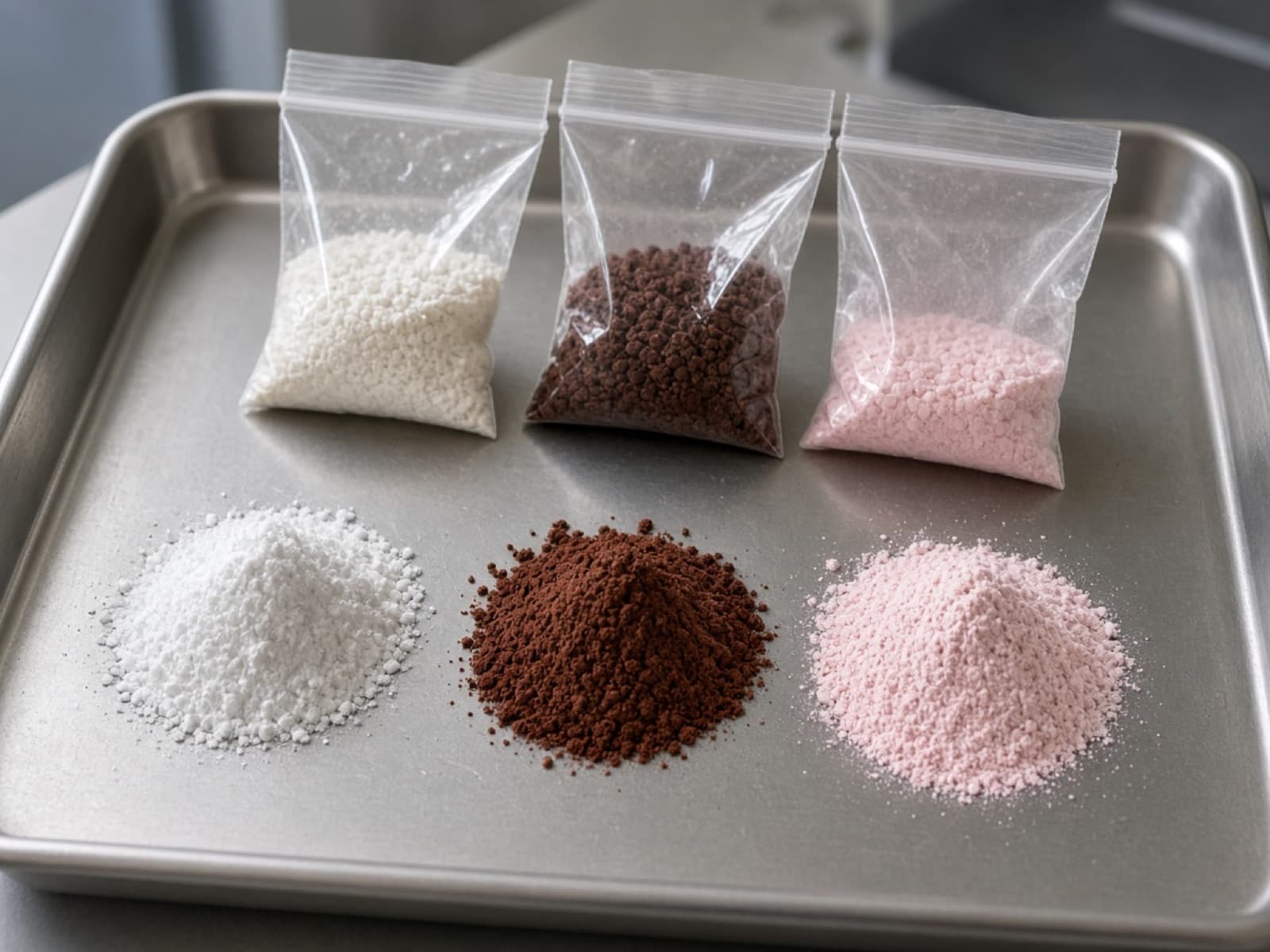
This guide covers zinc EDTA sold as an agricultural micronutrient fertilizer in bulk, for importers, distributors and traders. It does not cover zinc supplements, food or feed additives, or laboratory-grade EDTA reagents, which follow different specifications and rules.
What zinc EDTA is, and how it compares with zinc sulphate
A zinc chelate is a water-soluble zinc source in which Zn is bound to an organic chelating agent. For how buyers specify the agent and chelated share, see the Fe-EDDHA importer guide. For the unchelated salt see the zinc sulphate importer guide, and for wider trace-element trade the micronutrient fertiliser overview. Put the salt or chelate, Zn form and chelated share into the contract.
| Check | Zn-EDTA | Zinc sulphate |
|---|---|---|
| Zn form | Haifa Micro™ Zn15 (Haifa Group, October 2022): 15% Zn and 15% Zn chelated by EDTA, disodium complex, CAS 14025-21-9 | Mineral salt ZnSO4, monohydrate or heptahydrate (International Zinc Association) |
| Solubility | ca. 450 g/L at 20°C (Haifa) | Highly soluble (IZA); insolubles: see COA |
| Trade forms | Solid micro granules (Haifa). Nouryon (September 2021): micro-granular EDTA-ZnNa2 15.0% Zn w/w, EDTA-ZnK2 14.5% Zn w/w, liquid EDTA-Zn(NH4)2 9.0% Zn w/w | Granular, powder or crystal; monohydrate or heptahydrate (IZA) |
| Price basis | Per kg of product or per kg of chelated Zn, under FOB, CFR or CIF | Per kg of product or per kg of Zn, under FOB, CFR or CIF |
Grades and forms
Take the name, CAS and Zn % from the supplier's sheet or SDS. The Haifa sheet gives a 1% solution pH of 6, a pH stability range of 4 to 9, an untapped bulk density ca. 850 kg/m3, and the chemical name ethylenediaminetetraacetic acid zinc disodium complex (C10H12N2O8Na2Zn).
Nouryon lists liquid EDTA-Zn(NH4)2 (CAS 67859-51-2) at 1320 kg/m3, as % w/w. For a liquid, ask whether Zn is % w/w or % w/v, and convert with the lot density (L multiplied by kg/L gives kg). Use 15% Zn-EDTA only where the sheet states it.
COA checklist
| Parameter | Why it matters | Where to verify |
|---|---|---|
| Water-soluble Zn | Typologies floor; nutrient paid for | Lot COA |
| Chelated Zn and share | At least 80% of water-soluble Zn chelated | Lot COA |
| Chelating agent | "Chelated by" the named agent | COA and label; EN 13368-1:2014 identifies EDTA, not free vs bound |
| Free EDTA or Na | If the sheet states it | See COA |
| Solution pH | Haifa states a 1% solution pH | COA or sheet |
| Water insolubles | Dissolution | See COA |
| Moisture | Handling and storage | See COA |
| Density | Converts liquid w/w and w/v | Sheet or SDS |
| Heavy metals | PFC 1(C)(II) ceilings, mg/kg of total micronutrient | Lot COA |
| Method, lab, lot | Audit of the chelated share | Named method, accredited lab, lot number |
How prices are quoted
Compare offers per kg of product and per kg of chelated Zn. A 15% solid and a 9% w/w liquid are not the same product on a weight quote. Convert liquids to kg with lot density. Quote under ICC Incoterms 2020 as FOB, CFR or CIF. Salt, Zn %, chelated share, form, density, packing and load port all move the offer.
Packing, storage and shipping
PFC 1(C)(II), point 2 states: "Inorganic micronutrient fertilisers shall be made available to the end-user only in packaged form." The Haifa sheet lists 1 kg, 2 kg, 5 kg and 20 kg buckets. Take bag, lined-bag, drum or IBC sizes from the supplier's sheet.
A COMPO EXPERT SDS for disodium zinc EDTA (CAS 14025-21-9, fertiliser use, 21 September 2024), Section 7.2, says: "Protect from moisture." Section 14 states it is "Not regulated as a dangerous good" under ADN, ADR, RID, IMDG and IATA. Section 14.7, under the IMSBC Code, says: "Product is not allowed to be transported in bulk." Take Section 14 of the cargo SDS.
Supplier checks
State whether the seller is the manufacturer or a trader. Require a COA for every lot, with water-soluble Zn, chelated Zn, the agent and heavy metals, and an independent lab check of the chelated Zn share. Ask for a REACH statement (see HSE). Require an SDS with the CLP classification. The COMPO EXPERT SDS, under Regulation (EC) No 1272/2008, states: "Not a hazardous substance or mixture," with no hazard pictogram, signal word, hazard statement or precautionary statement required. For a CE-marked product, record the PFC and label qualifier, and take a sample first.
Regulations and standards
CE-marked zinc EDTA as a straight inorganic micronutrient fertiliser falls under PFC 1(C)(II)(a). The "Micronutrient chelate fertiliser" typology is "A water-soluble straight inorganic micronutrient fertiliser in which the declared micronutrient is chemically combined with chelating agent(s) fulfilling the requirements of CMC 1 in Part II of Annex II", and "5 % by mass of a micronutrient chelate fertiliser shall consist of a water-soluble micronutrient, and at least 80 % of the water-soluble micronutrient shall be chelated by a chelating agent fulfilling the requirements of CMC 1 in Part II of Annex II".
CMC 1, point 3(a) does not list permitted agents. The chelating agent "shall be an organic substance consisting in a molecule which: (i) has two or more sites that donate electron pairs to a central transition metal cation (zinc (Zn), copper (Cu), iron (Fe), manganese (Mn), magnesium (Mg), calcium (Ca) or cobalt (Co)), and (ii) is large enough to form a five- or six- membered cyclic structure." The product "shall remain stable in standard Hoagland solution at pH 7 and 8 for at least 3 days."
Contaminants must not exceed, "expressed in mg, in relation to the total micronutrient content expressed in kg": arsenic (As) 1 000, cadmium (Cd) 200, lead (Pb) 600, mercury (Hg) 100 and nickel (Ni) 2 000, not in mg/kg of product or dry matter.
Annex III requires, where declared micronutrients are chelated and each named agent "chelates at least 1 % water-soluble micronutrient", the qualifier "chelated by … (name of the chelating agent or its abbreviation)", "and the amount of chelated micronutrient as % by mass." It also requires the statement: "To be used only where there is a recognised need. Do not exceed the application rate."
EN 13368-1:2014, "Fertilizers - Determination of chelating agents in fertilizers by chromatography - Part 1: Determination of EDTA, HEEDTA and DTPA by ion chromatography", measures the total water-soluble fraction of each agent. It "does not allow to distinguish between the free form and the metal bound form of the chelating agents." It applies to zinc chelates at a mass fraction of at least 0,1%.
FAQ
How does Zn-EDTA compare with zinc sulphate for a buyer?
Zinc sulphate is a mineral salt, sold as monohydrate or heptahydrate, and is highly soluble, according to the International Zinc Association. Zn-EDTA is zinc combined with EDTA; cited disodium micro-granule sheets state 15% Zn chelated by EDTA. Compare them on form, Zn % and chelated share.
What is the difference between soluble Zn and chelated Zn on a COA?
Water-soluble Zn is the zinc that dissolves. Chelated Zn is the share combined with the named agent. For a CE-marked micronutrient chelate fertiliser, at least 80% of the water-soluble micronutrient must be chelated. EN 13368-1:2014 identifies EDTA but not free versus bound EDTA, so state chelated Zn on the COA.
How are bulk zinc EDTA prices quoted?
Offers are compared per kg of product and per kg of chelated Zn, under FOB, CFR or CIF as set out in ICC Incoterms 2020. Convert a solid and a liquid declared as % w/w or % w/v with the lot density. Salt, form, packing and load port also move the quote.
Is EDTA allowed under Regulation (EU) 2019/1009?
2019/1009 does not publish a closed list of permitted chelating agents. CMC 1, point 3(a), sets a structural test and requires stability in standard Hoagland solution at pH 7 and 8 for at least 3 days. A product that meets that rule and the 5% and 80% floors can be a CE-marked micronutrient chelate fertiliser.
Source zinc EDTA
To list or request fertilizer-grade zinc EDTA, request quotes or browse inorganic fertilizer listings on GetFertilizer.
Sources
- Haifa Micro™ Zn15 sheet, October 2022 (Haifa Group; 15% Zn, 15% Zn chelated by EDTA, CAS 14025-21-9, disodium complex, micro granules, pH, solubility, bulk density, bucket pack sizes)
- Nouryon, Dissolvine® Micronutrients product range, September 2021 (EDTA-ZnNa2 15.0% w/w, EDTA-ZnK2 14.5% w/w, liquid EDTA-Zn(NH4)2 9.0% w/w)
- Nouryon chelates product guide (E-Zn-15 CAS 14025-21-9, poured bulk density; E-Zn-9 CAS 67859-51-2, liquid density 1320 kg/m3)
- COMPO EXPERT, Zitrilon® SDS, revision 21 September 2024 (Disodium zinc EDTA, CAS 14025-21-9, fertiliser use, CLP, REACH, Section 7.2, Section 14)
- International Zinc Association, Zinc Fertilizer Overview (zinc sulphate as a water-soluble mineral salt; monohydrate and heptahydrate)
- SIS, SS-EN 13368-1:2014, Fertilizers - Determination of chelating agents in fertilizers by chromatography - Part 1: Determination of EDTA, HEEDTA and DTPA by ion chromatography
- Regulation (EU) 2019/1009, Annex I, Part II, Annex II, CMC 1 and Annex III, via legislation.gov.uk
- HSE, UK REACH registration
- ICC Incoterms 2020