

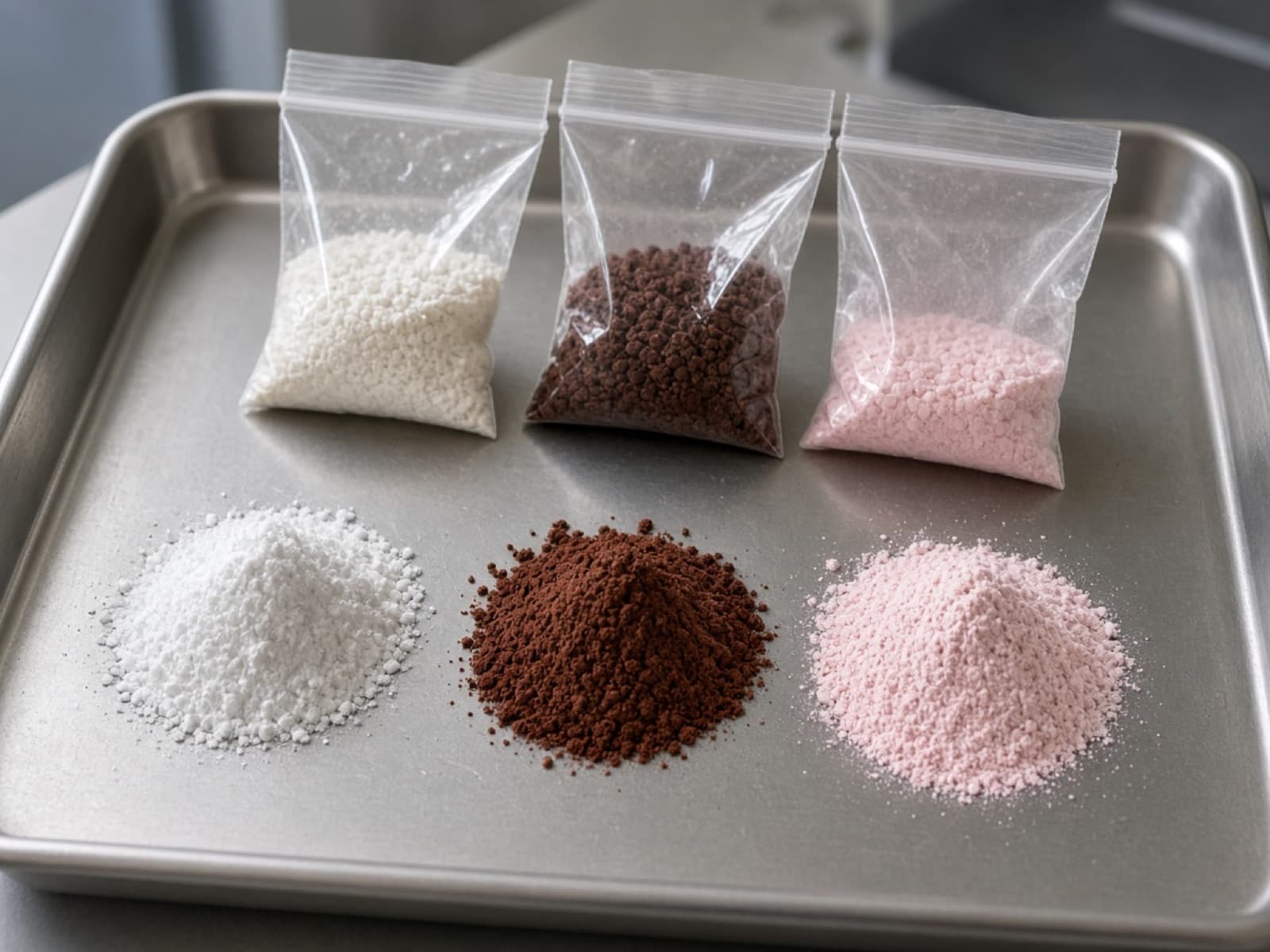
This guide covers fertilizer-grade iron chelates. It does not cover dietary supplements, aquarium treatments, houseplant products or medical chelation. The usual grades are Fe-EDDHA, Fe-DTPA, Fe-EDTA and Fe-HBED. Put the agent, chelated Fe and, for EDDHA, the o,o isomer into the contract.
Why Fe-EDDHA is specified
An iron chelate is a water-soluble iron source in which Fe is bound to an organic chelating agent so that it stays dissolved in a stated pH window. Buyers of micronutrient fertilisers specify the agent because Fe-EDTA, Fe-DTPA, Fe-EDDHA and Fe-HBED do not hold iron over the same range.
At-a-glance comparison
| Agent | pH stability (cited) | Typical buyer use | Forms on producer sheets |
|---|---|---|---|
| Fe-EDDHA | 3.5-12 (Haifa 4.8% o,o; Nouryon Q48); 3.5-10 (Nouryon Q40, 4.0% o,o) | High-pH programmes | Micro-granular solids |
| Fe-DTPA | 1.5-7.5 (Nouryon D-Fe-6, D-Fe-7, D-Fe-11) | Mid-pH liquid programmes | Liquid and solid |
| Fe-EDTA | 1.5-6.5 (Haifa Fe-EDTA 13%) | Acidic programmes | Micro-granules, liquids and crystals |
| Fe-HBED | 3.5-12 (Nouryon Fe-HBED 6%, 6.0% o,o-Fe) | High-pH programmes | Micro-granular solids |
Nouryon's greenhouse guide recommends DTPA below pH 6.5 and Fe-EDDHA or Fe-HBED above that; high calcium, or unchelated Mn, Zn or Cu, can narrow the window.
Grades and forms
Nouryon's micronutrients brochure (September 2021) lists iron chelates under the Dissolvine® brand, a Nouryon trademark, as liquids, micro-granules and crystals, with Fe as % w/w.
Fe-EDDHA
Haifa's Fe-EDDHA sheet (October 2022) states 6% iron, 6% iron chelated with EDDHA, and 4.8% iron chelated with EDDHA [o-o]. Nouryon lists 6.0% Fe EDDHA grades with 3.2% to 5.3% o,o-Fe. Compare those offers on o,o-Fe.
Fe-DTPA and Fe-EDTA
The same brochure lists liquid and solid Fe-DTPA and Fe-EDTA grades, with Fe as % w/w. Haifa's Fe-EDTA 13% sheet (October 2022) states 13% iron as micro-granules. For liquids, convert with the lot density (L multiplied by kg/L gives kg) before comparing w/v with w/w.
Fe-HBED
Nouryon lists a micro-granular Fe-HBED grade at 6.0% Fe and 6.0% o,o-Fe. PFC 1(C)(II) of Regulation (EU) 2019/1009 does not name HBED.
COA checklist
Require a lot COA, and name the method. Use EN 13368-2:2017 for Fe chelated by [o,o] EDDHA, [o,o] EDDHMA and HBED (ion pair chromatography), and EN 13368-1:2014 for EDTA, HEEDTA and DTPA (ion chromatography).
| Parameter | What to require |
|---|---|
| Total soluble Fe % | Lot COA vs contract |
| Chelated Fe % | Lot COA; at least 80% of water-soluble Fe chelated under the typologies |
| o,o and, if offered, o,p share | Lot COA by EN 13368-2 |
| Agent identity | Label and COA, "chelated by ..." under Annex III |
| Water-insoluble matter | Lot result and an agreed maximum |
| Moisture | Lot result and an agreed maximum |
| Density and pH, for liquids | Lot COA at a stated temperature, to convert L to kg |
| Form and particle size | Micro-granule, powder, crystal or liquid |
| Heavy metals | Lab report vs the 2019/1009 ceilings below |
| Method, lot number and lab | Named method, lot number and issuing lab |
How prices are quoted
Product basis versus chelated Fe or o,o-Fe
Sellers quote on a weight basis, in kg, or, for liquids, a volume basis, in L, under FOB, CFR or CIF, using Incoterms 2020. Compare per kg of product, per kg of chelated Fe, or per kg of o,o-Fe. A cheaper 6% Fe-EDDHA with a smaller o,o share can cost more on an o,o-Fe basis. Convert L to kg with the lot density, and state the agent, Fe and o,o guarantees, form, packing, origin and Incoterm.
Packing, storage and shipping
PFC 1(C)(II), point 2 states: "Inorganic micronutrient fertilisers shall be made available to the end-user only in packaged form." Haifa's EDDHA sheet lists 1 kg, 2 kg, 5 kg and 20 kg buckets; its EDTA 13% sheet lists 1 kg, 2 kg, 5 kg and 25 kg buckets. Take bag, lined-bag or drum sizes from the supplier's sheet. A 2025 SDS for Fe-EDDHA 6%, 4.8% o,o, Section 7.2, says: store in a well-ventilated place and keep cool. Section 10.5 says to keep away from strong acids, strong bases and oxidizing agents.
Supplier checks
Ask whether the supplier manufactures the chelate or trades it, and whether the plant can be named. Compare lot COAs with the offered total Fe, chelated Fe and o,o share, and use EN 13368-2 for an independent o,o check on the first lots. For a CE-marked cargo, ask for the EU declaration of conformity, the PFC 1(C)(II) typology and CMC 1 evidence. Confirm REACH and the CLP classification on the cargo SDS (the 2025 SDS above is not classified under Regulation (EC) 1272/2008), and take a pre-shipment sample.
Regulations and standards
A CE-marked, iron-only chelate is a PFC 1(C)(II) product under Annex I, Part II. Contaminant ceilings are in mg/kg of total micronutrient content: arsenic 1 000, cadmium 200, lead 600, mercury 100 and nickel 2 000. The typology "Micronutrient chelate fertiliser" has this minimum: "5 % by mass of a micronutrient chelate fertiliser shall consist of a water-soluble micronutrient, and at least 80 % of the water-soluble micronutrient shall be chelated by a chelating agent fulfilling the requirements of CMC 1 in Part II of Annex II". For "UVCB iron chelates", "at least 50 % of the water soluble iron shall be chelated by a chelating agent fulfilling the requirements of CMC 1 in Part II of Annex II". Annex I does not name EDTA, DTPA, EDDHA or HBED. CMC 1, point 3(a) states: "The chelating agent shall be an organic substance consisting in a molecule which: (i) has two or more sites that donate electron pairs to a central transition metal cation (zinc (Zn), copper (Cu), iron (Fe), manganese (Mn), magnesium (Mg), calcium (Ca) or cobalt (Co)), and (ii) is large enough to form a five- or six- membered cyclic structure. The EU fertilising product shall remain stable in standard Hoagland solution at pH 7 and 8 for at least 3 days." Annex III requires the qualifier "chelated by ... (name of the chelating agent or its abbreviation)" and the chelated micronutrient as % by mass, where each agent chelates at least 1 % water-soluble micronutrient. The named list including EDTA, DTPA, [o,o] EDDHA, [o,p] EDDHA, EDDHMA and HBED belonged to repealed Regulation (EC) 2003/2003 and is history. The legislation.gov.uk text is the IP-completion-day version. HSE sets out GB REACH duties. The same programmes often also use zinc sulphate, boron, MKP, potassium nitrate or calcium nitrate.
FAQ
What does o,o-EDDHA mean, and why should the COA state its share?
Ortho-ortho (o,o) EDDHA is the isomer that holds iron at high pH. Haifa's 6% Fe-EDDHA sheet states 4.8% iron as EDDHA [o-o]; Nouryon lists 6.0% Fe grades with 3.2% to 5.3% o,o-Fe. The COA should report that share by EN 13368-2. Two offers with the same total Fe can still differ in o,o-Fe.
What is the difference between soluble Fe % and chelated Fe %?
Total soluble iron is the water-soluble Fe on the COA. Chelated iron is the share bound to the declared agent. A fully chelated 6% grade can show the same figure for both, but report the two results separately. For a CE-marked micronutrient chelate fertiliser, at least 80% of the water-soluble micronutrient must be chelated.
How is bulk iron chelate quoted?
Offers are quoted on a weight basis, in kg, or, for liquids, a volume basis, in L, under an Incoterm such as FOB, CFR or CIF. Compare per kg of product, per kg of chelated Fe, or per kg of o,o-Fe, on the same Incoterm, using the lot density to convert L to kg.
Is Fe-EDDHA allowed under EU 2019/1009?
Yes, if the cargo meets a PFC 1(C)(II) typology, such as a micronutrient chelate fertiliser or UVCB iron chelates, and the chelating agent meets CMC 1, point 3. Annex I does not list EDDHA by name. The label must say "chelated by" the agent and state chelated iron as % by mass.
Source iron chelates
Post a request on GetFertilizer quote listings with the agent, Fe and o,o guarantees, form, quantity, packing and Incoterm, or browse inorganic fertilizer listings.
Sources
- Haifa HaiFer 48 Fe-EDDHA sheet, October 2022 (6% Fe, 6% Fe chelated by EDDHA, 4.8% o,o-Fe, pH stability 3.5-12, micro-granules, bucket pack sizes)
- Haifa Fe-EDTA 13% sheet, October 2022 (13% Fe, pH stability 1.5-6.5, micro-granules, bucket pack sizes)
- Nouryon micronutrients brochure, September 2021 (Dissolvine® trademark, Fe-EDDHA, Fe-DTPA, Fe-EDTA and Fe-HBED grades, forms, % w/w, o,o-Fe grades)
- Nouryon, Nutrient solutions for greenhouse crops (numeric pH stability for Fe-DTPA, Fe-EDDHA and Fe-HBED; o,o-Fe as the high-pH active share)
- Van Iperen Oligo Basic Iron-EDDHA 6% sheet (6% total Fe, 3% [o,o]-EDDHA)
- Van Iperen Fe-EDDHA SDS, July 2011, Section 7.2
- Easygro Fe-EDDHA 6% 4.8% o,o SDS, revision 9 July 2025, Sections 2, 7.2 and 10.5 (CLP not classified, REACH registration number, storage and incompatibilities)
- DIN EN 13368-1:2014-04: Fertilizers - Determination of chelating agents in fertilizers by chromatography - Part 1: Determination of EDTA, HEEDTA and DTPA by ion chromatography (EN 13368-1:2014)
- DIN EN 13368-2:2018-03: Fertilizers - Determination of chelating agents in fertilizers by chromatography - Part 2: Determination of Fe chelated by [o,o] EDDHA, [o,o] EDDHMA and HBED, or the amount of chelating agents, by ion pair chromatography (EN 13368-2:2017)
- Regulation (EU) 2019/1009, Annex I, Part II, Annex II, CMC 1, Annex III and Article 6, via legislation.gov.uk
- HSE, UK REACH registration
- ICC Incoterms 2020