

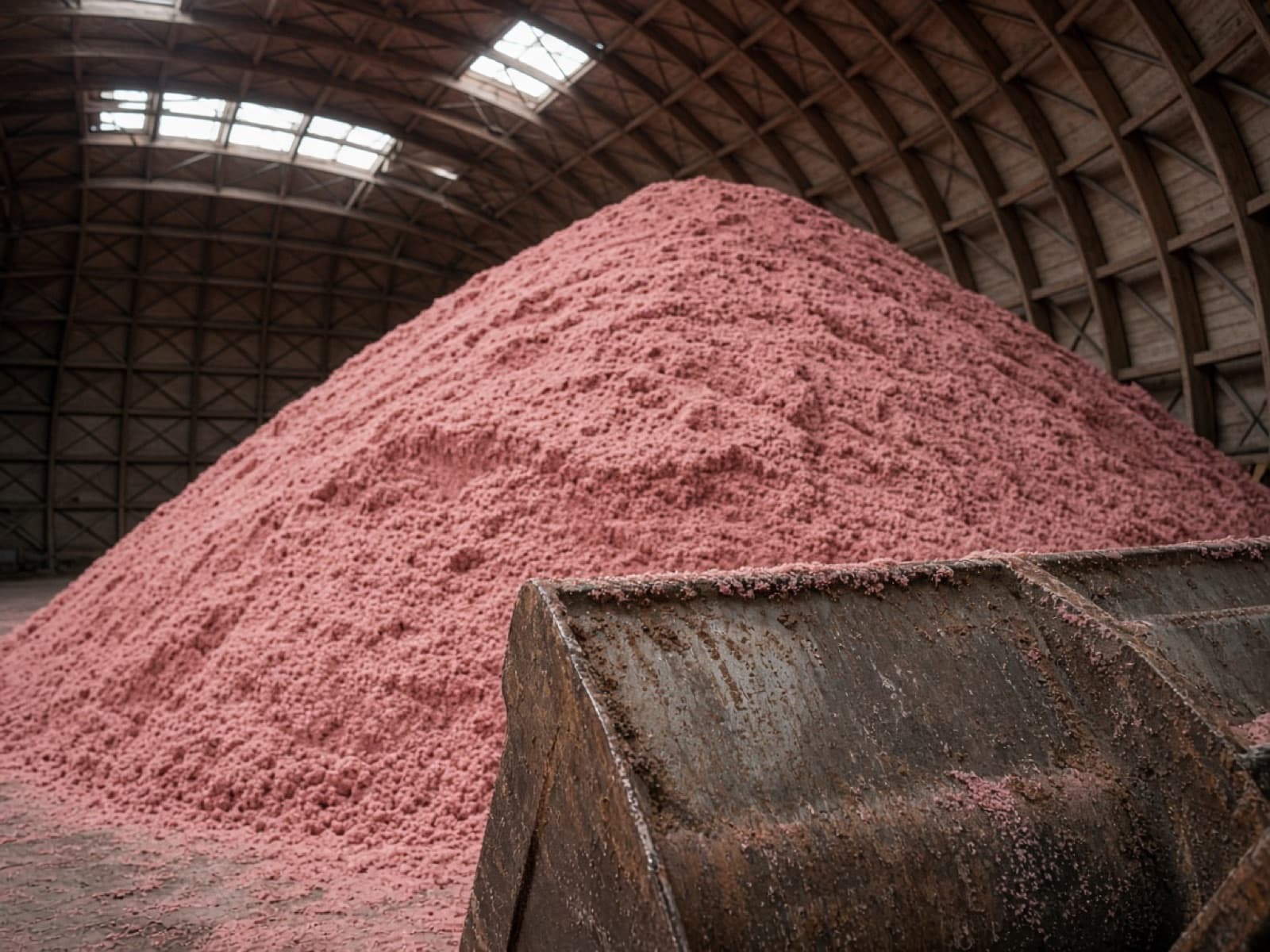
Importers buying monopotassium phosphate fertilizer in bulk need to agree on a few things before signing: the grade and particle size their customers use, the COA limits the supplier will guarantee, the price basis for comparing offers, and how the bags stay dry in transit. MKP goes mostly to fertigation suppliers and to plants that make water-soluble NPK, and both groups reject material that leaves residue in a tank.
What MKP is
Monopotassium phosphate is KH2PO4, also sold as mono potassium phosphate or potassium dihydrogen phosphate (CAS 7778-77-0). It supplies phosphorus and potassium and contains no nitrogen. Haifa describes its MKP as fully water soluble, 100% plant nutrients, and free of chloride and sodium (Haifa, MKP product page). Because it carries no nitrogen, growers use it at stages where they want to hold nitrogen down, such as early root establishment and the fruiting stages of sugar-rich crops.
MKP grades and forms
What 0-52-34 means
MKP 0-52-34 means 0% N, 52% P2O5 and 34% K2O. Expressed as elements, that is 22.7% P and 28.2% K (ICL, Nova PeaK 0-52-34). Haifa's technical sheet sets minimums of 51.5% P2O5 and 34% K2O on a dry basis, with typical values of 52% and 34.3% (Haifa MKP technical sheet).
Fertilizer vs technical grade, crystal vs fine powder
Producers sell fertilizer MKP under different grade names. Haifa labels its 0-52-34 product "technical grade" and supplies it as white crystals. Its screen analysis allows at most 5% retained on 18 US mesh (above 1.0 mm) and at most 10% passing 120 US mesh (below 0.125 mm) (Haifa MKP technical sheet). Other suppliers offer finer powder. Ask each supplier for the grade name, a full spec sheet and a screen analysis, because a grade label alone does not tell you what is in the bag.
Food grade MKP is outside the scope of this guide.
MKP vs MAP vs potassium nitrate
These three fully soluble salts often sit side by side in a distributor's fertigation range. The figures below come from Haifa product pages.
| MKP | MAP (soluble grade) | Potassium nitrate | |
|---|---|---|---|
| N-P2O5-K2O | 0-52-34 | 12-61-0 | 13-0-46 |
| Solubility at 20 °C | 22.6 g/100 g water | 37.4 g/100 g water | 316 g/L water |
| pH | 4.4 (1% solution) | Moderately low | 9.9 (1% solution) |
| Typical use | P and K with no N | P with ammonium N, early season | K with nitrate N |
| Tank mixing | Not with Ca or Mg fertilizers | Not with Ca or Mg fertilizers | Wide compatibility, per Haifa |
Sources: Haifa MKP, Haifa MAP, Haifa Multi-K brochure, Haifa Multi-K advantages.
The soluble MAP here differs from the granular MAP traded for soil application. For that product, see our bulk DAP and MAP buying guide. For potassium nitrate, read our potassium nitrate analysis.
Specs to check on the COA
Ask for a certificate of analysis for each lot, tied to the lot number printed on the bags. The reference values below come from Haifa's MKP technical sheet. Where no figure is given, agree a limit with your supplier and your own customers.
| Parameter | Reference (Haifa MKP) | What to ask for |
|---|---|---|
| P2O5 % | 51.5 min (dry basis) | Guaranteed minimum and test method |
| K2O % | 34 min (dry basis) | Guaranteed minimum and test method |
| Water insolubles | 0.1% max | A maximum in % or ppm; fertigation buyers care most about this one |
| Moisture (loss on drying) | 0.1% max | Maximum, with method |
| Solution pH | 4.2 to 4.7 (1% solution) | Range and the concentration tested |
| Chloride | 0.01% max | Maximum |
| Sodium | No figure published | A stated maximum, since buyers expect it sodium free |
| Heavy metals | Iron 20 ppm max; no others listed | Cd, Pb, As and Hg results that meet your import market's limits |
| Particle size | 5% max above 1.0 mm; 10% max below 0.125 mm | Full screen analysis |
Source: Haifa MKP technical sheet.
Packaging, shipping and storage
Haifa ships MKP in 25 kg polyethylene or laminated polypropylene bags, and in 500, 1,000 and 1,200 kg big bags with a woven polypropylene outer, polyethylene liner, discharge spout and lifting loops (Haifa MKP technical sheet). Fertigation distributors usually resell the 25 kg bags. Soluble NPK plants tend to take big bags.
Water-soluble MKP has to arrive dry and free flowing. Specify lined bags, dry containers, and dunnage or liners on the container floor. Store pallets off the ground in a covered warehouse. If the COA guarantees a loss on drying, check caked or damp bags against that figure on arrival.
How bulk MKP is priced
Suppliers quote bulk MKP on a weight basis for the product, usually FOB or CFR, and some container trades use DAP terms. The main drivers of MKP price:
- Input costs, mainly phosphoric acid and potash
- Purity and grade, including the insolubles limit
- Origin and producer
- Packaging: 25 kg bags or big bags
- Freight and the delivery term
Put every offer on the same Incoterm, packaging and payment terms before comparing. Our guides to bulk potash (MOP and SOP) and phosphorus fertilizers cover those materials.
Supplier checks for importers
- Producer or trader: Find out whether the seller makes the MKP or resells it. If it is a trader, get the producer's name and plant on the COA.
- Lot consistency: Ask for COAs from several recent lots. Large swings in P2O5, K2O or insolubles point to process or sourcing problems.
- Third-party inspection: Have an independent inspector sample and test at loading for assay, insolubles, moisture and packing.
- Dissolve test: Dissolve a pre-shipment sample in water at the rate your customers use. Look for haze or sediment, and filter and weigh any residue against the insolubles limit.
- Payment terms: With a new supplier, use a letter of credit or tie payment to inspection results rather than paying fully in advance.
Import compliance
Many countries require fertilizer registration before sale, a label declaring nutrient content, and limits on contaminants such as cadmium. This guide does not cite specific rules for any market. Check registration, labeling, contaminant limits and the HS code with your local authority and customs broker before you ship. If you also import soluble NPK, the bulk NPK fertilizer guide covers similar checks.
FAQ
What is MKP fertilizer?
MKP fertilizer is monopotassium phosphate, KH2PO4, a fully water-soluble salt that supplies phosphorus and potassium with no nitrogen. The standard grade is 0-52-34. Producers such as Haifa describe it as chloride and sodium free. Importers sell it mainly to fertigation suppliers and to plants that make water-soluble NPK blends.
What does 0-52-34 mean?
0-52-34 is the nutrient analysis: 0% nitrogen, 52% P2O5 and 34% K2O by weight. In elemental terms, ICL lists this as 22.7% phosphorus and 28.2% potassium. Haifa's technical sheet guarantees at least 51.5% P2O5 and 34% K2O on a dry basis, so check the minimums on each supplier's COA.
Why is MKP used in fertigation and water-soluble NPK blends?
MKP dissolves fully, leaves little residue, and adds no nitrogen, chloride or sodium. Haifa's sheet caps insoluble matter at 0.1%. Formulators use it to set the P and K in a blend without changing the nitrogen. It should not be mixed in the same tank with calcium or magnesium fertilizers.
When does a distributor stock MKP vs MAP vs potassium nitrate?
Distributors stock MKP for customers who need phosphorus and potassium while keeping nitrogen low. Soluble MAP (12-61-0) gives more phosphorus along with ammonium nitrogen and suits early season programs. Potassium nitrate (13-0-46) supplies potassium with nitrate nitrogen. Many fertigation distributors carry all three so growers can adjust the ratio by crop stage.
Sourcing or selling MKP? Post an MKP buy request on GetFertilizer with your grade, COA limits, quantity in kg, packing and delivery terms. Suppliers can list product in the inorganic fertilizers category.