

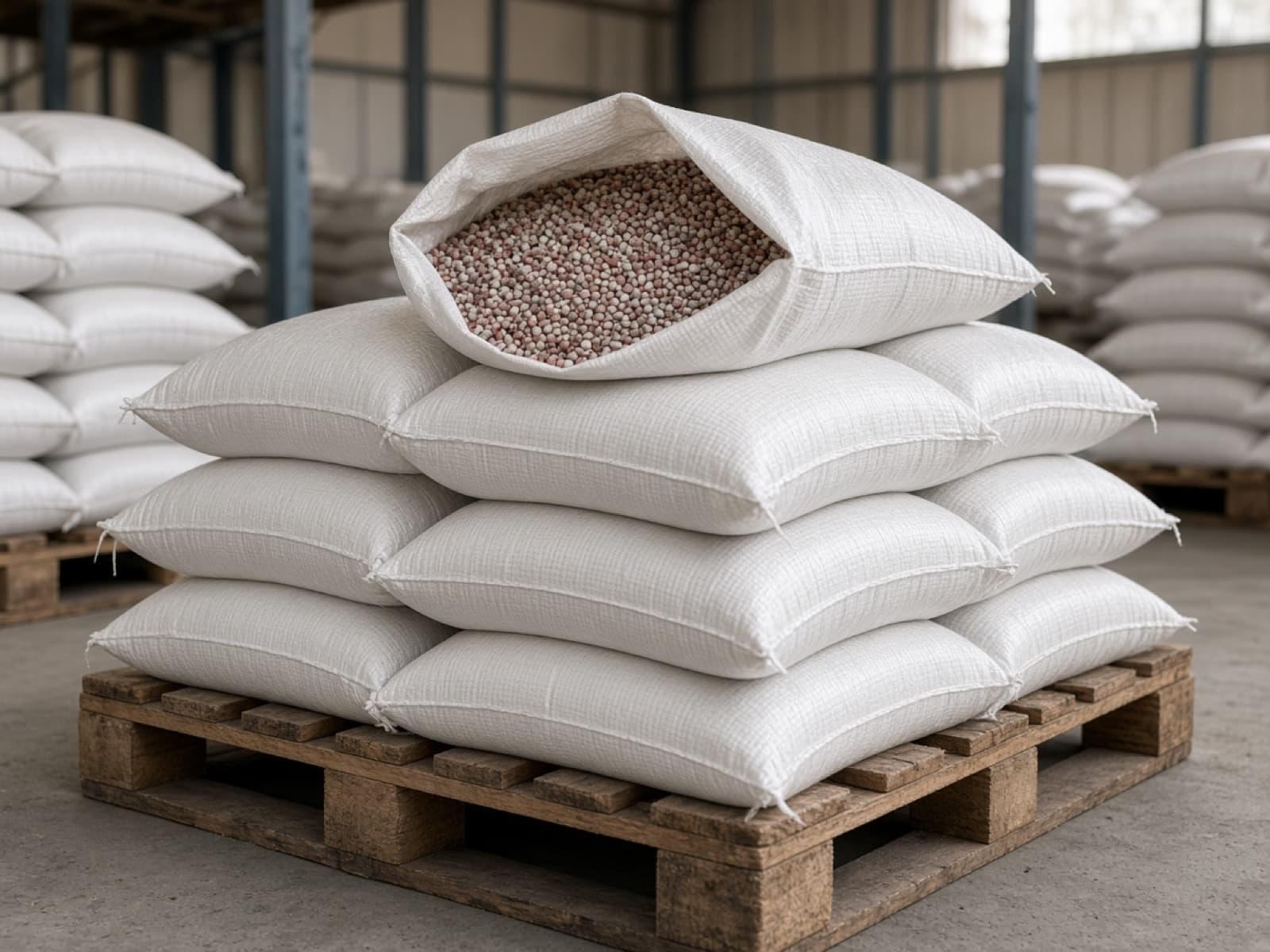
If you buy nutrients for resale, blending, or distribution, bulk NPK fertilizer is usually on the shortlist. This guide is for fertilizer importers, distributors, blenders, and agrochemical traders who negotiate cargoes, big bags, or container lots. It covers grade labels, compound versus blend, packaging, FOB versus CIF, and the documents that keep quotes comparable.
In trade terms, "bulk NPK" means large commercial volumes, not retail garden bags. Cargoes move as loose product in holds, in flexible intermediate bulk containers (FIBCs / big bags), or in bagged lots stuffed into containers. The numbers on the label (for example 15-15-15 or 20-10-10) are the N-P2O5-K2O guarantee. Form, moisture, particle size, physical integrity, Incoterm, and inspection decide whether arrival matches the contract.
How NPK grades work on a commercial contract
Reading the N-P-K guarantee
NPK grades are written as three numbers: nitrogen (N), phosphate as P2O5, and potash as K2O. A 15-15-15 grade claims equal parts of those three nutrient oxides by weight under the labeling rules the seller uses. Ask which standard or method the guarantee follows, and whether secondary nutrients (sulfur, magnesium, calcium) or micronutrients are part of the offer or sold separately.
Common commercial patterns include balanced grades, high-nitrogen grades for cereal programs, and high-phosphate or high-potash grades for specific crop plans. Do not assume two "15-15-15" offers are identical. Ask for the full chemical analysis and the raw-material basis (urea or ammonium nitrate for N; MAP, DAP, or SSP/TSP routes for P; MOP or SOP for K).
Compound NPK versus blends
Compound (or complex) NPK is produced so each granule carries the stated nutrient ratio. Blends (bulk blends / BB) mix straight or intermediate fertilizers so the bulk average matches the grade. Both are legitimate in trade. They handle differently.
Compound granules usually give more even nutrient distribution per particle and can reduce segregation on long conveyors. Blends can be cheaper or more flexible when a plant changes recipes often, but they need careful mixing, matched particle sizes, and careful loading so the pile does not segregate. Put "compound vs blend" on the RFQ as a hard field. If the buyer will bag for resale or run precision spreaders, say that up front.
Specs that belong on every RFQ
Write minimum or maximum values for the parameters that drive claims:
- N, P2O5, and K2O guarantees (and secondary nutrients if contracted)
- Moisture (max; high moisture raises caking and handling risk)
- Particle size / granulometry (range or screen percentages)
- Crushing strength or hardness where the destination uses mechanical handling
- Dust or fines content
- Color or appearance only if your market treats them as commercial requirements
- Foreign matter limits for bulk handling
- Chloride source for K (MOP vs SOP) when the crop or soil program forbids chloride
A bulk NPK fertilizer offer without moisture, particle size, and compound-versus-blend detail is incomplete. Do not leave those as "seller's standard" if downstream customers have spreader or blending constraints.
Packaging and logistics
Loose bulk on a vessel suits large importers with port storage and belt or grab discharge. Moisture control, hatch integrity, and clean holds matter; many NPK grades cake when they pick up humidity. Big bags (often 500 kg, 1,000 kg, or similar FIBC sizes agreed in the contract) suit mid-volume buyers and warehouses without bulk discharge. Containerized bagged NPK suits smaller parcels or destinations where breakbulk is impractical.
State packaging clearly: bulk in hold, FIBC size and liner type, or bag size and bag material. Ask who supplies bags and who pays for them. Moisture barriers, UV resistance for outdoor storage, and lifting loops rated for your forklifts or cranes reduce damage at destination. Soft granules, high fines, and weak bags create dust claims and short weights even when chemistry is fine.
Incoterms for NPK cargoes: FOB and CIF in practice
Incoterms allocate cost and risk between seller and buyer. For bulk NPK fertilizer, FOB and CIF (or CFR) are the usual frame for ocean cargoes. Put the named place or port in the contract; the three-letter term alone is not enough.
Under FOB, the seller delivers on board at the named loading port. The buyer typically arranges and pays ocean freight and insurance, and often controls vessel nomination and schedule. That helps if you already have liner contracts or want freight visibility separate from the fertilizer price.
Under CIF, the seller arranges carriage to the named destination port and provides minimum insurance cover as defined in the Incoterms rules you adopt. The buyer still clears import formalities and handles onward inland moves. CIF can simplify quoting when you lack a freight desk, but freight and insurance are harder to unbundle when you compare suppliers.
Neither term is automatically cheaper. Compare all-in landed cost: product, packaging, freight, insurance, inspection, demurrage risk, and local charges. For big-bag or container lots, sellers sometimes quote EXW, FCA, or CPT; map those to your pickup capacity.
Documents and quality checks
Treat quality as a paper trail plus physical verification.
Typical documents for an NPK shipment include:
- Commercial invoice and packing list
- Bill of lading (or sea waybill) matching the Incoterm and ports
- Certificate of Analysis (COA) for the contracted lot or production batch
- Safety Data Sheet (SDS)
- Certificate of origin when required by the importer's customs or preference scheme
- Local certificates only when the destination authority asks for them
- Insurance certificate when the seller must provide cover (for example under CIF)
Pre-shipment inspection by an independent surveyor is common for first trades or large cargoes. Agree who nominates the inspector, who pays, where samples are drawn (plant, warehouse, or vessel), and which methods apply. Sampling should follow a written plan so both sides accept the COA. Holdback samples help if a destination lab later disagrees with the loadport result.
On arrival, weigh and sample according to your local practice before blending or bagging. Compare results to contractual tolerances for chemistry and physicals. Put claims procedures and time limits in the sales contract before the vessel sails.
How to evaluate NPK fertilizer suppliers
Price alone is a weak filter. Check whether the seller can load the volume, grade, and form you need.
Capacity and production: confirm availability for your parcel size, and whether the offer is from a compounding plant, a blending plant, or secondary stock.
Origin and feedstock: single-origin dependency exposes you to export restrictions, port congestion, and feedstock outages. Asking for alternate load ports or origins on the RFQ shows real options. For potash, ask whether K comes as MOP or SOP when chloride limits matter.
Export experience: request recent shipment references for your destination region. Ask how they handle inspection, bagging, and document turnaround for compound versus blend cargoes.
Commercial terms: letter of credit (LC) and telegraphic transfer (TT) remain common. LC gives documentary protection when parties are new to each other; TT may suit repeat counterparties with clear credit history. Agree currency, payment triggers (against docs, against BL, or other milestones), and any deposit rules in writing. Circulate draft LC text early so bank wording does not stall loading.
Compliance: confirm the seller can provide the certificates your import license and destination rules require. Run sanction and restricted-party screening on your side too.
B2B platforms can gather multiple quotes in one format, but you still need the same grade, compound-versus-blend flag, Incoterms, and document checklist on every inquiry.
RFQ checklist for comparable quotes
Put the same fields in every request so replies line up:
- Product: bulk NPK fertilizer, target grade (for example 15-15-15)
- Form: compound or blend (do not leave blank)
- Quantity (kg), with tolerance (for example ±5% or as agreed)
- Specs: N / P2O5 / K2O mins, moisture max, particle size, dust/fines, crushing strength if needed
- K source: MOP or SOP when relevant
- Secondary nutrients or micronutrients: included or excluded
- Packaging: bulk / FIBC size / bag size; liner requirements
- Delivery window and preferred load or discharge ports
- Incoterm and named place/port (FOB Loadport X, CIF Discharge Y, etc.)
- Inspection: yes/no, nominating party, payment of fees
- Documents required (COA, SDS, origin, BL type)
- Payment method preference (LC or TT) and currency
- Validity of offer and production or stock basis
- Any destination restrictions or labeling rules
Ask suppliers to quote unit price, packaging cost if separate, and freight/insurance only when those sit inside their Incoterm. Reject incomplete replies.
Closing notes for professional buyers
Lock grade, compound versus blend, and physical specs before you argue freight. Choose an Incoterm that matches who controls the voyage. Refuse vague COAs. Write moisture, particle size, and K source into the contract when they matter downstream. Use inspection and sampling rules both sides signed. Then compare NPK fertilizer suppliers on capacity, documents, and payment terms with the same RFQ template.