

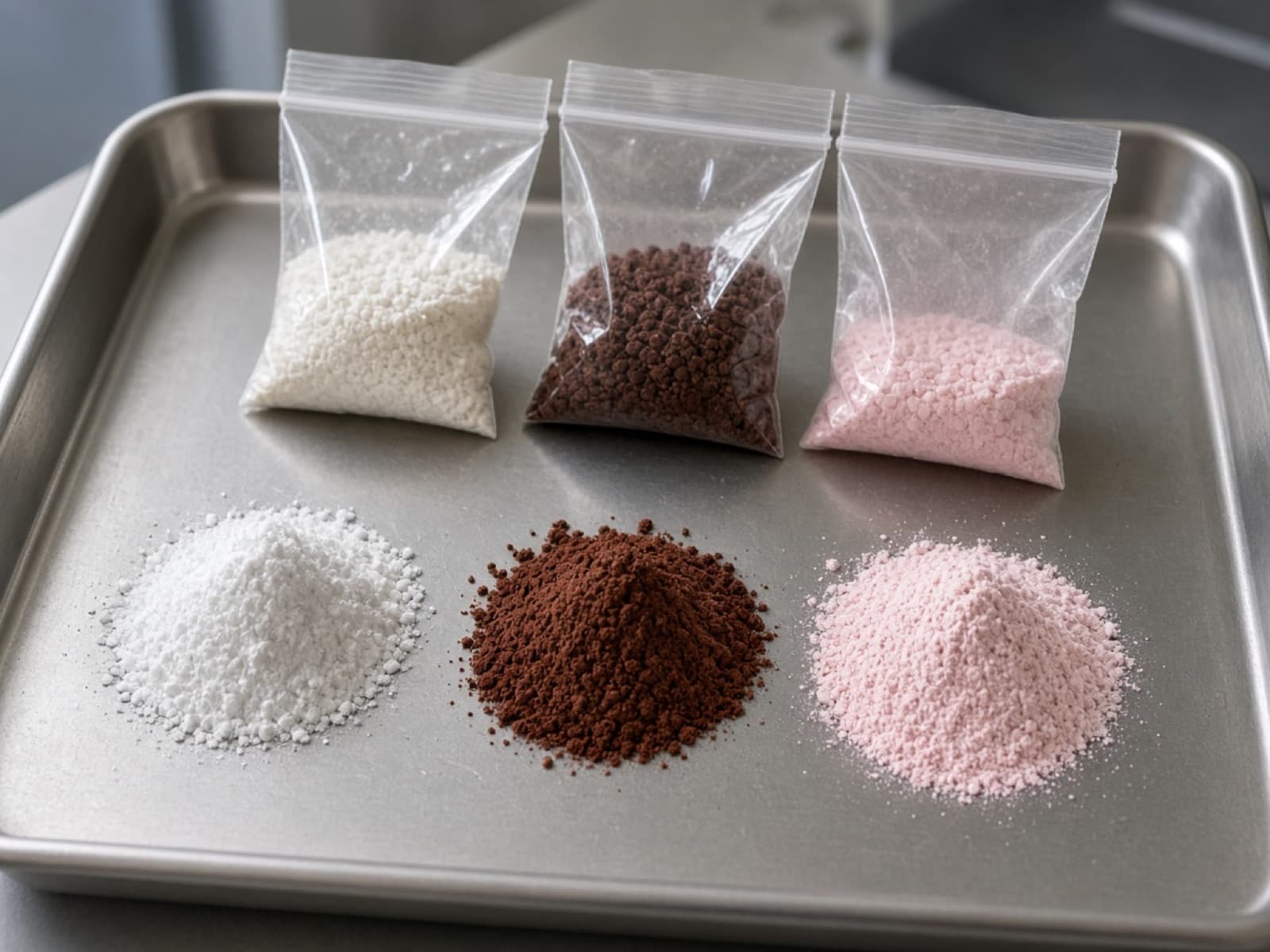
Before you contract for boron fertilizer, agree the grade, whether the guarantee is elemental boron (B) or boric oxide (B2O3), packing and destination documents. This guide is for importers, distributors, blenders and formulators of fertilizer-grade borates. It does not cover cleaning, pest-control or craft uses. Crops need only small amounts of boron, and the gap between deficiency and toxicity is narrow. Application rates belong to the agronomist.
Who buys bulk boron fertilizer
Buyers are usually importers and distributors that supply blending plants, or formulators of water-soluble grades. Blenders add boron to bulk NPK compounds or bulk blends. Soluble-grade plants may include it in mixes of MKP or potassium nitrate. The same checks apply if you already buy zinc sulphate. See our micronutrient fertilisers article.
Products and grades
Name the chemical form in the contract. The usual solids are borax decahydrate, borax pentahydrate, boric acid, disodium octaborate tetrahydrate (DOT) and granular borates made from pentahydrate.
Borax decahydrate (Na2B4O7·10H2O) carries more water of crystallisation than the pentahydrate, so it has less boron per unit mass. U.S. Borax conversion factors give B2O3 as 0.3652 of the pure decahydrate.
Borax pentahydrate (Na2B4O7·5H2O) is the usual soil and blend grade. The U.S. Borax Fertibor specification guarantees 15.0-15.3% water-soluble B and 48.3-49.3% equivalent B2O3. Eti Maden's ETIBOR-48 sheet, issued via Etiproducts, specifies B2O3 at 48.00-49.35%, Na2O at 21.37-21.95% and water insolubles at 150 ppm maximum. U.S. Borax Granubor is pentahydrate at 15% B, screened between -4 and +14 mesh, with an average particle size of around 2.8 mm. The sheet describes it as 100% water-soluble, with a gradual boron release rate.
Boric acid (H3BO3) is used in soluble formulations. The Optibor TG specification guarantees 56.25-56.80% B2O3 and 99.9-100.9% equivalent H3BO3.
DOT is disodium octaborate tetrahydrate (Na2B8O13·4H2O). The U.S. Borax product data sheet states 20.5% B and a particle size of less than 75 microns. It is sold under trade names such as Solubor. For liquid boron, take composition, B content, density and packing from the SDS and lot COA.
B content, B2O3 and how quotes are compared
The USGS Mineral Commodity Summaries for boron (February 2026) states that boron products are priced and sold based on their B2O3 content. To compare grades, convert to elemental B. U.S. Borax converts B2O3 to B by multiplying by 0.31074 (reciprocal 3.218). On that factor, Fertibor's 48.3% B2O3 equals 15.0% B. Contract whether the COA reports B, B2O3 or both, and convert before comparing offers.
Solids are quoted on a weight basis, in kg. Liquids are quoted on a volume basis, in L, or by weight if the offer says so. The fair comparison is landed value per kg of B under an Incoterm such as FOB, CFR or CIF. Confirm net fill and whether packing is inside the quote.
COA and specification checks
Require a lot COA with methods and results, not a brochure typical. Name whether the guarantee is B or B2O3, and name the method.
| Parameter | Why it matters | Where to verify |
|---|---|---|
| B or B2O3 content, with the method | Sets the nutrient you pay for; convert before comparing | Lot COA vs contract. For more than 10% B, EN 17042:2018 (acidimetric titration); for 10% B or less, EN 17041:2018 (azomethine-H), or the EN method named in the contract |
| Water insolubles | Filter and nozzle risk | Lot result; ETIBOR-48 specifies 150 ppm maximum |
| Solubility | Blend granules vs dissolving grades | Producer sheet and an agreed minimum |
| Moisture or water of crystallisation | Distinguishes decahydrate from pentahydrate | Grade identity on the contract and lot result |
| Particle size | Blending, dust and dissolving | Agreed sieve range; Granubor -4 to +14 mesh; DOT less than 75 microns |
| Na or Ca | Sodium load on sodium borates; calcium if a calcium borate is offered | Lot COA; ETIBOR-48 specifies Na2O at 21.37-21.95% |
| Heavy metals | Destination compliance | Accredited lab report against the market's limits |
Packing, shipping and storage
Trade packing for solids is commonly 25 kg bags and 1,000 kg big bags. A U.S. Borax agriculture data sheet lists 25 kg polyethylene bags and 1,000 kg IBCs. U.S. Borax's handling and storage bulletin says sodium borates and boric acid are normally supplied in 25 kg bags, and also in 1,100 kg IBCs. Liquids move in drums or IBCs as the SDS states, quoted per L. The bulletin tells users to store borates in a dry warehouse, preferably on wooden pallets, with bags kept off a concrete or earthen floor, and to rotate first-in, first-out. Compaction can form friable lumps. If boric acid picks up moisture it can cake. Follow the cargo SDS.
Compliance and import documents
Annex VI of Regulation (EC) No 1272/2008, in the Publications Office consolidated text dated 1 December 2023, classifies boric acid, disodium tetraborate (anhydrous, pentahydrate and decahydrate) and disodium octaborate (anhydrous and tetrahydrate) as Repr. 1B, H360FD. Those entries set no specific concentration limit, so Annex I, Table 3.7.2 applies the generic 0.3% limit for Category 1B reproductive toxicants.
Boric acid and disodium tetraborate are substances of very high concern. The UK REACH Candidate List published by HSE records boric acid (EC 233-139-2, CAS 10043-35-3) and disodium tetraborate, anhydrous (EC 215-540-4, CAS 1330-43-4, 12179-04-3 and 1303-96-4, covering the penta- and decahydrates) as included on 18 June 2010 for toxic for reproduction (Article 57c). Disodium octaborate is listed from 27 June 2018. ECHA's website did not load for this research, so check the current EU Candidate List entry.
For a CE-marked boron fertiliser, Regulation (EU) 2019/1009, Annex I, Part II places a boron-only product in PFC 1(C)(II) (inorganic micronutrient fertiliser), to be made available to the end-user only in packaged form. A straight micronutrient salt fertiliser must contain at least 10% by mass of a water-soluble micronutrient. Contaminant ceilings, in mg per kg of total micronutrient content, are 1000 for arsenic, 200 for cadmium, 600 for lead, 100 for mercury and 2000 for nickel. Annex III requires the nutrient to be listed as boron (B) with the name of the counter-ion, and the statement: "To be used only where there is a recognised need. Do not exceed the application rate." Products that are not CE marked may follow a national fertilizer route. Ask your broker for the COA, origin certificate, invoice, packing list, transport document and SDS.
Where supply comes from
In the 2026 boron chapter, USGS reports that three companies in southern California produced borates in 2025 and that U.S. production figures are withheld. For U.S. imports in 2021-24, in all forms, the sources were Turkey 90%, Bolivia 6% and other 4%. Fertilizer-grade borates are commonly offered from Turkish production, including Eti Maden, and from U.S. Borax in California.
Supplier checks before you sign
Ask whether the supplier manufactures the borate or trades it. Compare recent lot COAs with the offered B or B2O3 guarantee and the named method. Book independent sampling at loading and a third-party test by the contracted EN method. Tie payment to those papers, the SDS and classification, and to remedies for an off-spec assay.
FAQ
Why compare offers on kg of B?
Decahydrate, pentahydrate, boric acid and DOT do not contain the same share of B. Convert each offer to landed value per kg of B on the same Incoterm, using the 0.31074 factor when the quote or COA is in B2O3.
What is the difference between borax pentahydrate and decahydrate?
Decahydrate has more bound water, so less boron per kg. U.S. Borax gives B2O3 as 0.3652 of pure decahydrate, against 0.4780 of pure pentahydrate. Contract the hydrate and the assay.
Which EN method should be on the COA?
For mineral fertilizers with more than 10% B, the Government Chemist summary names EN 17042:2018 (acidimetric titration). For 10% B or less, it names EN 17041:2018 (azomethine-H spectrometry).
What classification and SVHC paperwork is needed?
Boric acid, the common sodium tetraborates and DOT are Repr. 1B, H360FD, with the 0.3% generic concentration limit, and are on the Candidate List for reproductive toxicity. Require a current SDS.
Source boron fertilizer on GetFertilizer
Post a request on GetFertilizer quote listings with grade, B or B2O3 guarantee, quantity in kg or L, packing and Incoterm. Browse inorganic fertilizer listings to compare offers.
Sources
- U.S. Borax Fertibor specification
- U.S. Borax Granubor product data sheet and Granubor technical details
- U.S. Borax Optibor TG specification
- U.S. Borax Solubor product data sheet (disodium octaborate tetrahydrate, 20.5% B)
- U.S. Borax conversion factors (November 2025)
- U.S. Borax borate handling and storage bulletin
- Solubor DF product data sheet (25 kg bags and 1,000 kg IBCs)
- Eti Maden ETIBOR-48 specification, via Etiproducts
- USGS Mineral Commodity Summaries 2026, Boron
- Government Chemist, CEN updates affecting chemical measurements, July 2018 (EN 17041:2018 and EN 17042:2018)
- Regulation (EC) No 1272/2008, Annex VI, Publications Office consolidated text, 1 December 2023
- Regulation (EC) No 1272/2008, Annex I, Table 3.7.2, via legislation.gov.uk (26 July 2019 consolidation)
- Regulation (EU) 2019/1009, Annex I, Part II and Annex III, via legislation.gov.uk
- UK REACH Candidate List, HSE (boric acid and disodium tetraborate, inclusion date 18 June 2010)