

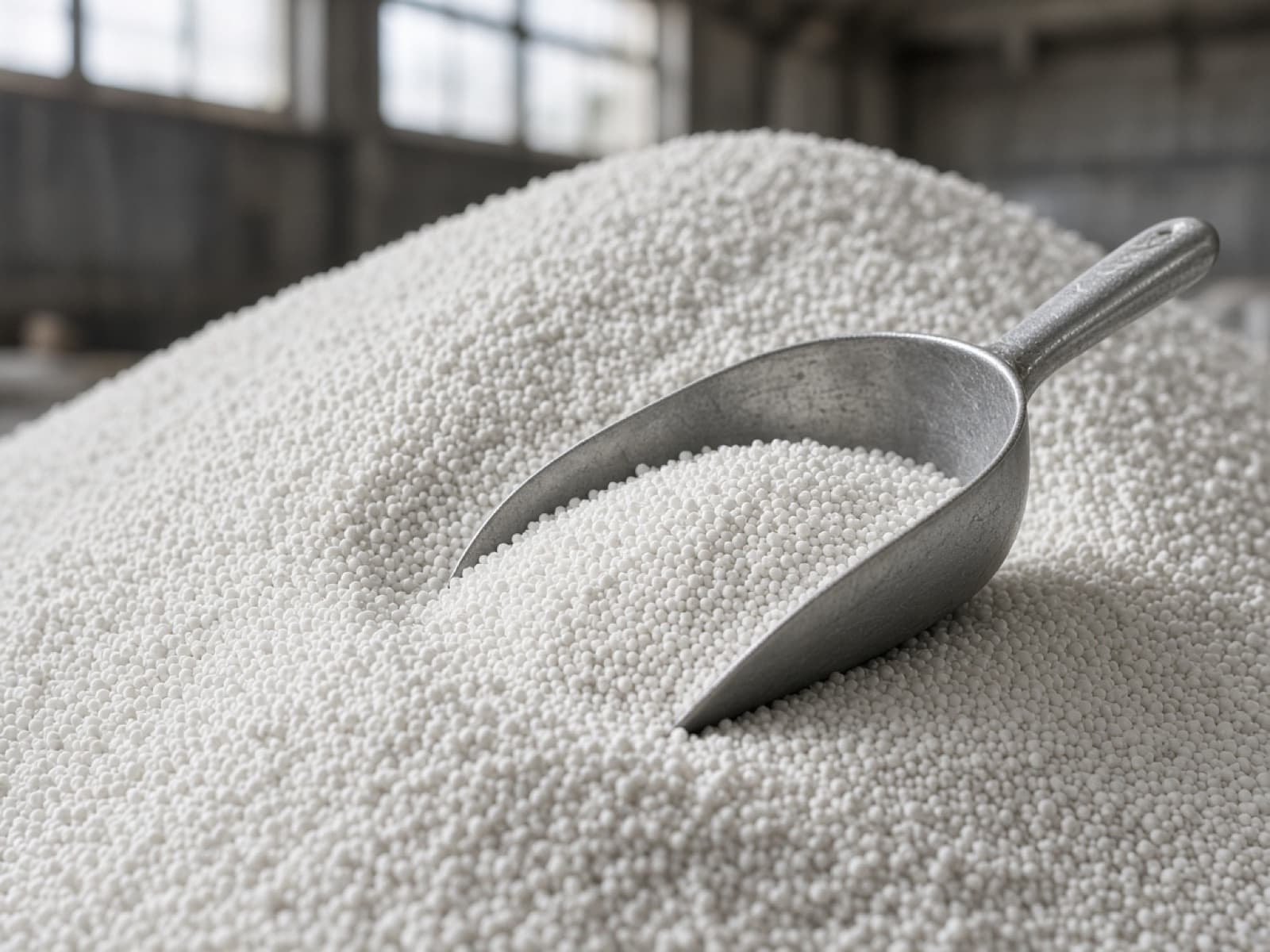
This guide covers fertilizer-grade ammonium sulfate nitrate (ASN, also written ammonium sulphate nitrate). It does not cover laboratory reagents or chemistry-homework use. Put the grade, N split, S or SO3 guarantee, AN content by mass, and the cargo SDS into the contract.
What ASN is and how it differs from ammonium sulfate and CAN
ASN is a solid nitrogen-and-sulphur fertiliser made from ammonium nitrate and ammonium sulphate, supplying nitrate-N, ammoniacal N and sulphate-S in one granule. Ammonium sulfate supplies only ammoniacal N plus sulphate-S. Ammonium nitrate and CAN supply nitrate and ammoniacal N; CAN uses a limestone or dolomite filler, and declared S is not a defining feature. See UAN, ATS, calcium nitrate, magnesium nitrate and bentonite sulphur.
Dual nitrogen plus sulphur
A Grupa Azoty 26 (+13) grade is declared as 26% total N (7.3% nitrate, 18.7% ammoniacal) and 32.5% water-soluble SO3 (13% S). A 30 (+7) grade from the same producer is 30% total N (12% nitrate, 18% ammoniacal) and 17.5% SO3 (7% S).
Versus ammonium sulfate and CAN
| ASN | Ammonium sulfate | CAN | |
|---|---|---|---|
| N form | Nitrate and ammoniacal | Ammoniacal only | Nitrate and ammoniacal |
| S content | S or SO3; sourced 13% S or 7% S | 24% S (60% SO3), OCI 21% N | See COA |
| Trade forms | Granules | Solid (OCI mid-size) | Granular; see CAN guide |
| AN sensitivity | Changes the SDS UN entry | No AN on the OCI sheet | AN plus limestone or dolomite; see SDS |
| Price basis | Per kg product, N, sometimes S | Per kg product, N or S | Per kg product or N |
Grades and forms
Solid grades
The sheets cited here describe granules: 95% at 2.0 to 6.3 mm on the Grupa Azoty 26 and 30 grades, and at least 90% at 2 to 5 mm on Duslo and Lovochemie 26+13 grades. For prill or compact forms, use the supplier's sheet.
What AN content by mass means
Using IUPAC 2021 abridged standard atomic weights (H 1.008, N 14.007, O 15.999), NH4NO3 has a molar mass of 80.043 and is 35.0% N (28.014/80.043). N from ammonium nitrate is about 0.350 times the AN mass fraction. The 26 family SDS lists 39 to 44% AN; the 30 grade SDS lists 65 to 69%. Transport classification uses AN by mass; EU 2019/1009 uses N from ammonium nitrate.
COA checklist
| Check | Require |
|---|---|
| Total N | Guarantee and method |
| Nitrate N and ammoniacal N | Both, against the grade sheet |
| S or SO3 | As contracted |
| AN content by mass | On the COA or SDS |
| Moisture | Azoty max 0.8% |
| Particle size | Share in the contracted band |
| Crushing strength or caking | If the sheet states a figure or treatment |
| Heavy metals | PFC 1(C)(I) ceilings in 2019/1009 |
| Oil retention or porosity | If the high-N AN heading applies |
| Test method, lot and lab | Named method (Azoty 26 plus: PN-EN 15476, 15475, 15749, 1235), lot, lab |
Shipping, packing and storage
Dangerous goods classification
Read SDS section 14 for that grade. The Grupa Azoty 26 grade SDS marks UN number, class, packing group and ADR, RID and IMDG as "Not applicable." The 30 grade SDS assigns UN 2067, ammonium nitrate fertilizer, class 5.1, packing group III, classification code O2. Fertilizers Europe (2024) assigns UN 2067 when 45% < AN < 70% and AN + ammonium sulphate > 70%, and treats some mixtures with AN at or below 45% as non-UN-classified.
Packing, moisture and storage
Azoty lists 25 kg and 50 kg polyethylene bags, big bags and bulk; Duslo lists 600 kg and 1,000 kg big bags and loose product. Moisture on the Azoty sheet and SDS is max 0.8%. Lovochemie states a surface anti-agglomeration treatment. Section 7 of the Grupa Azoty SDS requires a clean, dry building, protected from water, rain, snow, direct sunlight and heating above 30°C, away from the incompatibles listed there, and not under canopy roofs or in open yards.
How prices are quoted
Product versus N or S basis
Compare offers per kg of product, per kg of N, and sometimes per kg of S, under a named Incoterm. Normalise 26+13 and 30+7 grades to N, and to S if needed.
FOB, CFR, CIF and DG surcharges
Quote under ICC Incoterms 2020 as FOB, CFR or CIF. If the SDS assigns UN 2067, freight can include a dangerous-goods surcharge. Grade, AN content, packing and load port all move the offer.
Supplier checks
Name the manufacturer or trader and plant. Require a COA per lot with the N split, S or SO3, moisture and AN content, plus a pre-shipment N-split and S test. Ask for a REACH statement (see HSE) and the cargo SDS; read section 2 for CLP and section 14 for that grade's UN entry. For a CE-marked product, record the PFC and module. Module A1 is required only if the high-N AN heading applies; otherwise Module A may be used for CMC 1 and CMC 11, and some CE files use Module D1.
Regulations and standards
A CE-marked ASN with declared N and S falls under PFC 1(C)(I)(a)(i), which covers a product with "only one primary macronutrient (nitrogen (N), phosphorus (P), potassium (K)) and one or more secondary macronutrients (calcium (Ca), magnesium (Mg), sodium (Na), sulphur (S))". In that case the nitrogen content shall be at least "3 % by mass of total nitrogen (N)", the sulphur content at least "1,5 % by mass of total sulphur trioxide (SO 3)", and "The sum of all declared primary and secondary macronutrient contents shall be at least 18 % by mass." PFC 1(C)(I)(a)(ii) is for other nutrient combinations.
PFC 1(C)(I)(a)(i-ii)(A) applies only where the product "shall be ammonium nitrate (NH 4 NO 3)-based and contain 28 % or more by mass of nitrogen (N) as a result of ammonium nitrate (NH 4 NO 3)". The sourced 26 and 30 grades sit below that threshold. Oil retention, detonation resistance, packaged-only supply and Module A1 apply only then.
Where P2O5-equivalent is less than 5%, PFC 1(C)(I) ceilings include cadmium (Cd) 3 mg/kg dry matter, Cr VI 2, Hg 1, Ni 100, Pb 120, As 40, and perchlorate 50 mg/kg dry matter. Take CLP from SDS section 2 (26 grade: H319; 30 grade: H272 and H319) and the UN entry from section 14. As history only, Regulation (EC) No 2003/2003 listed the type "Ammonium sulphate-nitrate" with "25 % N" and a "Minimum nitric nitrogen content: 5 %."
FAQ
What is ASN, and how does it differ from ammonium sulfate and CAN?
ASN is a solid fertiliser of ammonium nitrate and ammonium sulphate supplying nitrate-N, ammoniacal N and sulphate-S in one granule. Ammonium sulfate supplies only ammoniacal N plus sulphate-S. CAN supplies nitrate and ammoniacal N with a limestone or dolomite filler; declared S is not a defining feature.
What N and S should the COA show, and how is the N split reported?
The COA should show total N, nitrate N, ammoniacal N, and S or SO3 against the contracted grade. Sourced 26+13 grades declare 26% N, a stated N split, and 13% S or 32.5% SO3. A sourced 30+7 grade declares 30% N (12% nitrate, 18% ammoniacal) and 17.5% SO3 (7% S).
Why does ammonium nitrate content matter for EU rules and shipping?
Transport rules use AN by mass. A sourced 26 grade SDS marks ADR as not applicable; a 30 grade at 65 to 69% AN is UN 2067, class 5.1, packing group III. EU 2019/1009 tests for 28% or more N from ammonium nitrate, which those grades do not meet.
Does EU 2019/1009 cover ASN, and which PFC and AN-content rules apply?
Yes, a CE-marked cargo with declared N and S falls under PFC 1(C)(I)(a)(i) when the typologies minima are met. The compound typologies do not apply. PFC 1(C)(I)(a)(i-ii)(A) applies only at 28% or more N from ammonium nitrate, which the sourced grades do not reach.
Source ammonium sulfate nitrate
To list or request fertilizer-grade ASN, request quotes or browse inorganic fertilizer listings on GetFertilizer.
Sources
- IUPAC, 2021 abridged standard atomic weights (H 1.008, N 14.007, O 15.999)
- Grupa Azoty, Saletrosan 26 plus product page (PFC 1(C)(I)(a)(i); 26% N, 7.3% nitrate N, 18.7% ammoniacal N, 32.5% SO3 / 13% S; granules 95% at 2.0-6.3 mm; not subject to RID and ADR; H319)
- Grupa Azoty, Saletrosan 26 plus specification NA/2/2024, valid from 17 July 2024 (same nutrient figures; moisture max. 0.8%; 25 kg and 50 kg polyethylene bags, big bags and bulk; test methods PN-EN 15476, 15475, 15749 and 1235)
- Grupa Azoty, Saletrosan 26 family SDS, English version, PDF dated 25 February 2020 (AN 39-44% for the 26 family; water up to 0.8%; section 2 H319; section 7 storage; section 14 Not applicable)
- Grupa Azoty, Saletrosan 30 product page (PFC 1(C)(I)(a)(i); 30% N, 12% nitrate N, 18% ammoniacal N, 17.5% SO3 / 7% S; class 5.1, UN 2067, packing group III)
- Grupa Azoty, Saletrosan 30 SDS, revision 7 November 2018 (AN 65 to 69%; section 2 H272 and H319; section 14 UN 2067, class 5.1, packing group III, classification code O2)
- Duslo, DASA 26/13 sheet (26.0% N, 18.5% ammoniacal, 7.5% nitrate, 13.0% water-soluble S; min. 90% at 2-5 mm; PE 25 kg, big bags 600 kg and 1,000 kg, loose)
- Lovochemie, Lovodasa 26+13S sheet, August 2019 (26% N, 8.7% nitrate, 17.3% ammoniacal, 13% S; min. 90% at 2-5 mm; surface treated against agglomeration)
- OCI Nitrogen, ammonium sulphate 21N (+24S) sheet, 1 January 2021 (21% ammoniacal N, 24% S, 60% SO3)
- Fertilizers Europe, Guidance for sea transport of solid ammonium nitrate based fertilizers, 2024 (UN 2067 composition categories for AN + ammonium sulphate)
- Regulation (EU) 2019/1009, Annex I, Part II and Annex IV, Part I, via legislation.gov.uk
- Regulation (EC) No 2003/2003, Annex I, type designation Ammonium sulphate-nitrate, via legislation.gov.uk, historical only
- HSE, UK REACH registration
- ICC Incoterms 2020