

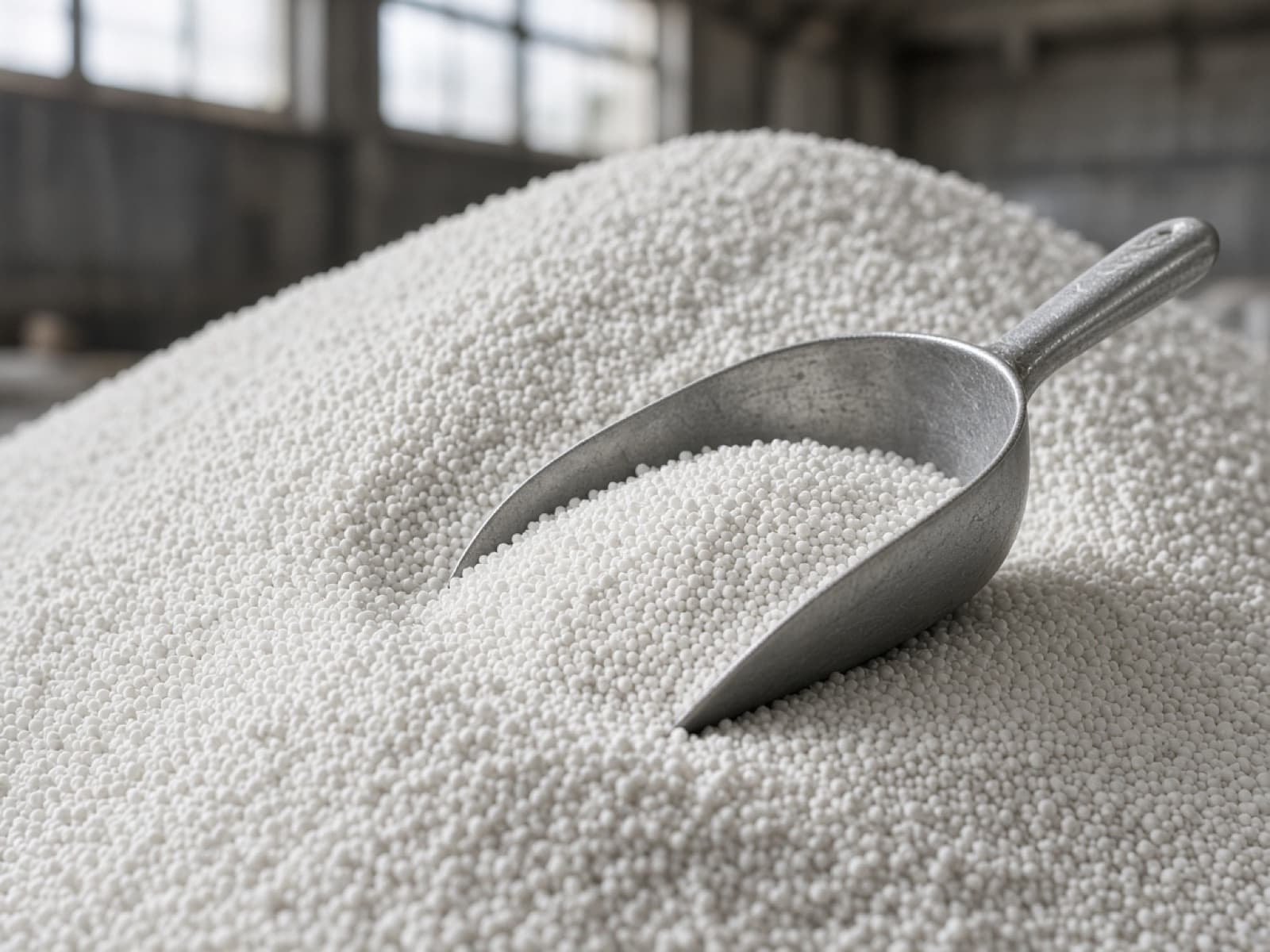
This guide covers only fertilizer-grade ammonium thiosulfate (ATS, 12-0-0-26S, also spelled ammonium thiosulphate). Photographic-fixer and mining grades are outside this article.
What it is and who buys it
Fertilizer ATS is a clear aqueous ammonium thiosulfate solution that supplies ammoniacal nitrogen and sulphur. Tessenderlo Kerley's Thio-Sul product sheet gives the formula as (NH4)2S2O3. Importers, liquid distributors, blend plants and co-ops buy it for liquid programs, including mixes with UAN.
Grades and specifications
The standard 12-0-0-26S solution
12-0-0-26S is the standard grade. Tessenderlo's product sheet states 12% N as ammoniacal nitrogen and 26% S, by weight, with no phosphate or potash. At a typical density of 1.33 kg/L at 25 °C, the same sheet lists 160 g/L N and 346 g/L S (16% N and 34.6% S w/v). A 2025 brochure writes the volume grade as 16-0-0-35S, rounding the sulphur line.
On that sheet, salt-out is +7 °C and pH is 6.8 to 8.8. The May 2026 application guide and the storage and handling guide list salt-out at +4 °C, crystallization at about 0 °C, and a recommended minimum storage temperature of 8 °C. Use the current sheet for the cargo and keep storage at or above that minimum. The SDS gives a typical pH of 7 to 8 and a relative density of 1.32 to 1.35.
Potassium thiosulfate and calcium thiosulfate are different products. Contract them on separate purchase orders.
How bulk ATS is priced
ATS is quoted on a weight basis or a volume basis under a named Incoterm such as FOB, CFR or CIF, at a named port. If offers mix kg and L, convert with the cargo density on the COA, using the lot figure. Tessenderlo's storage guide says the product is supplied principally in bulk, by railcar, tank truck or isotainer (ISO tank), and is also offered in 1,000 L IBCs and 16,000 L flexibags. Confirm net fill, tare and whether tank rental, cleaning and inspection sit inside the quote. Ask how ammonia and sulphur inputs, freight for a liquid cargo, and spring demand affect availability. Match grade, density and packing before ranking offers, because a lower density changes how much nitrogen and sulphur you receive per L.
COA and specification checks
Require a lot COA with methods and results, not a product brochure. Agree whose analysis is final, how retained samples are kept, and how density is measured for invoice conversion.
| Parameter | Why it matters | Where to verify |
|---|---|---|
| Total N | Sets the grade and the nitrogen paid for | Lot COA vs contract; Tessenderlo 12% N w/w, ammoniacal |
| Total S | Sets the sulphur guarantee | Lot COA vs contract; Tessenderlo 26% S w/w |
| Density (kg/L) | Converts weight and volume quotes | COA at the stated temperature; typical 1.33 kg/L at 25 °C, range 1.32 to 1.35 kg/L |
| pH | Affects corrosion, decomposition and blend compatibility | Lot result; product sheet 6.8 to 8.8, SDS typical 7 to 8 |
| Salt-out or crystallization temperature | Warns of cold-weather precipitation | Producer sheet for that cargo (see the range above) |
| Appearance and clarity | Cloudy or off-color lots may be contaminated or crystallized | Visual check against "clear, colorless to light yellow" |
| Insolubles | Protects filters and nozzles | Lot result if needed; no maximum on the sheets fetched here |
| Heavy metals | Destination compliance | Accredited lab report against the market's limits |
Blending and compatibility
Tessenderlo describes ATS as compatible with nitrogen solutions, including UAN, and with complete N-P-K liquid blends that are neutral to slightly acidic. The application and storage guides both say it cannot be used with acidic materials below pH 6.0. The SDS states that acids release sulfur dioxide, a respiratory hazard, and that alkalis accelerate the evolution of ammonia. Strong oxidizers such as nitrates, nitrites or chlorates can form explosive mixtures if heated to dryness. Copper, zinc and their alloys (bronze, brass, galvanized metals) should not be used in handling systems or storage containers. Run a jar test for every new recipe, including UAN or micronutrient mixes, and get written supplier confirmation before blending.
Packing, shipping and storage
Agree clean, dedicated tanks and a previous-cargo certificate before loading. For IBCs, drums and totes, Tessenderlo's storage guide requires cool, dry, well-ventilated storage out of direct sunlight, at or above 8 °C and not above 49 °C; above 50 °C, corrosion and decomposition risk increases. Keep smaller containers out of the sun, and store the solution away from combustibles, heat and flame, as the SDS requires.
In cold weather, keep the cargo above the producer's recommended minimum. The storage guide recommends insulation or heating for tanks and tankers moving into colder areas, and says crystallized product can be reheated before unloading. It lists carbon or mild steel, stainless steel (grade 304 or higher), aluminum, HDPE or suitable fiberglass for full-strength ATS. See the APP guide for similar ISO tank, flexitank and IBC checks.
ATS vs ammonium sulfate and elemental sulphur
ATS is a liquid that supplies ammoniacal nitrogen and thiosulfate sulphur in one solution, which is why liquid blenders use it with UAN. Ammonium sulfate is a dry crystal or granule that supplies ammonium nitrogen and sulfate sulphur, and needs bag or bulk-solid logistics rather than tanks. Bentonite sulphur is a dry elemental-sulphur product. It carries no nitrogen and has to oxidize in the soil before the sulphur is in sulfate form.
Compare landed value per kg of the nutrient you need, using the COA, and count tank costs against dry storage. Specs and packing for the dry products are in our ammonium sulfate and bentonite sulphur guides.
Compliance and import documents
For CE-marked EU fertilising products, Regulation (EU) 2019/1009, Annex I, PFC 1(C)(I) sets contaminant limits. For inorganic macronutrient fertilizers with less than 5% P2O5-equivalent by mass, the cadmium ceiling is 0.000003 kg/kg dry matter, lead is 0.000120 kg/kg dry matter and mercury is 0.000001 kg/kg dry matter. ATS has no declared phosphate, so that cadmium line applies. Figures are converted to kg from the regulation's published units and apply only in this category. Products that are not CE marked may follow a national fertilizer route instead.
Ask your broker for the COA, certificate of origin, invoice, packing list, transport document and SDS, plus permits where required. Tessenderlo's SDS names the product ammonium thiosulfate solution, states it is not regulated by DOT, IATA, TDG, ADR or ADG, and gives no UN number. The storage guide adds that it is not subject to ADR, RID, ADN or IMDG; other rules may apply to bulk sea transport.
Supplier checks before you sign
Ask whether the supplier manufactures the solution or trades another plant's output. Verify the producing plant and compare recent lot COAs with the offered N, S, density and pH guarantees. Book independent sampling at loading, with a tank cleanliness certificate and previous-cargo documents. On arrival, check density and pH against the COA. Tie payment to those papers and to remedies for off-spec density, nutrient content, contamination or crystallization.
FAQ
What is ammonium thiosulfate fertilizer, and what does 12-0-0-26S mean?
It is a clear liquid fertilizer supplying ammoniacal nitrogen and sulphur. 12-0-0-26S means 12% N, no P2O5, no K2O, and 26% S, all by weight.
Why do distributors and blenders buy ATS?
They want a liquid source of nitrogen and sulphur that can be pumped, stored in tanks and blended with other liquids, including UAN.
How is bulk ATS priced?
Offers are quoted on a weight basis or a volume basis under an Incoterm such as FOB, CFR or CIF, with a named port and packing. If quotes mix kg and L, convert with the density on the lot COA.
Which products is ATS not compatible with, and what happens if it is mixed wrongly?
Tessenderlo says not to mix it with acidic materials below pH 6.0. The SDS warns that acids release sulfur dioxide, that alkalis accelerate ammonia evolution, and that strong oxidizers such as nitrates, nitrites or chlorates can form explosive mixtures if heated to dryness.
Source ATS on GetFertilizer
Post an ATS request on GetFertilizer quote listings with grade, quantity in kg or L, density basis, packing and Incoterm. Browse inorganic fertilizer listings to compare offers.
Sources
- Tessenderlo Kerley Thio-Sul product sheet (N, S, density, pH, appearance, salt-out +7 °C)
- Tessenderlo Kerley Thio-Sul application guide (compatibility with UAN, acidic materials below pH 6.0, salt-out +4 °C, crystallization about 0 °C, minimum storage 8 °C)
- Tessenderlo Kerley Thio-Sul brochure (16-0-0-35S volume grade, density, pH, salt-out +4 °C)
- Tessenderlo Kerley Thio-Sul SDS, revision 16 September 2024 (typical pH and density, incompatibilities, transport classification)
- Tessenderlo Kerley Thio-Sul storage and handling guide (ISO tanks, 1,000 L IBCs, 16,000 L flexibags, storage temperatures, tank materials, jar test)
- Regulation (EU) 2019/1009, Annex I, PFC 1(C)(I), via legislation.gov.uk