

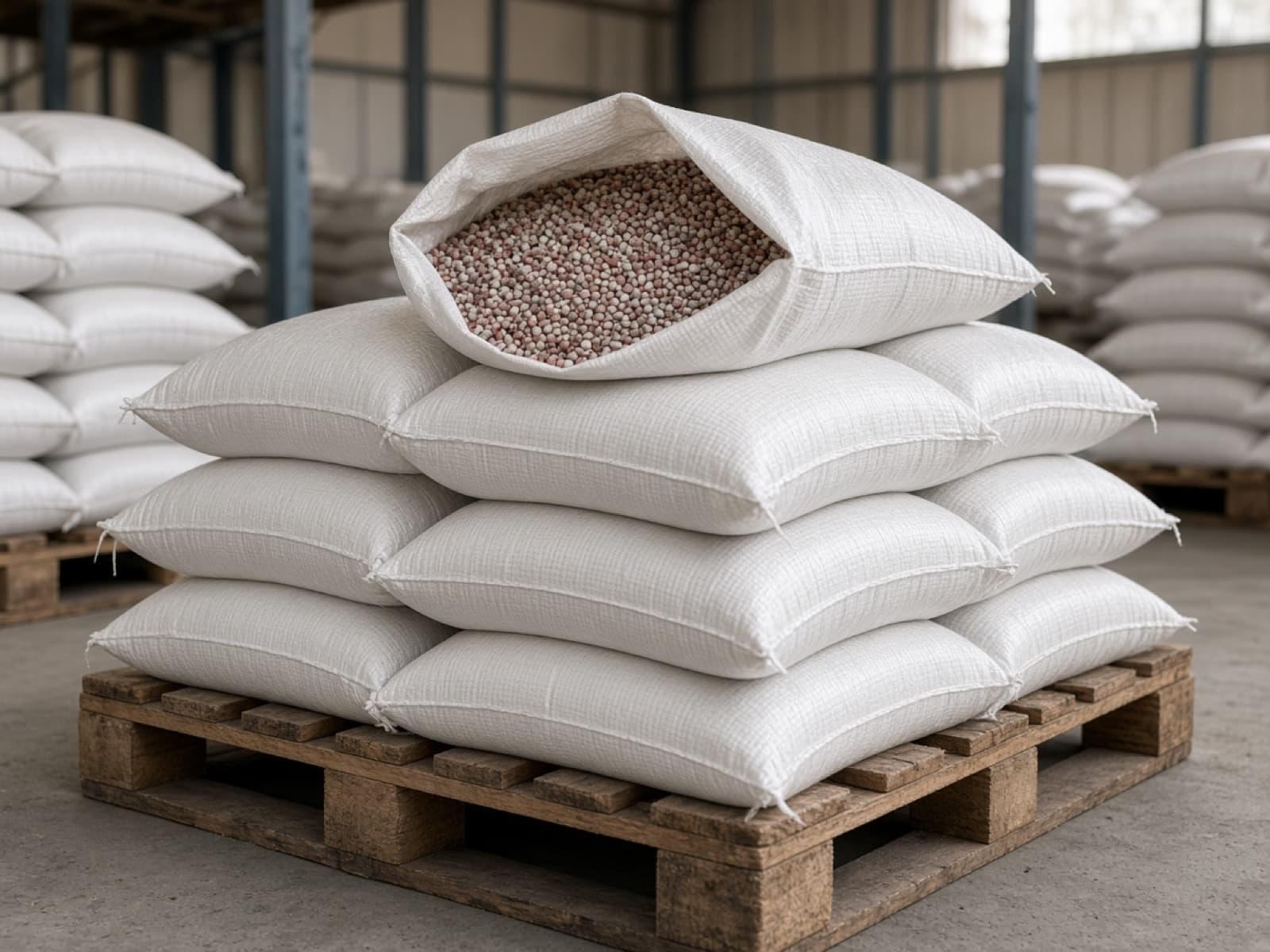
Importers and blenders buying bentonite sulphur fertilizer in bulk have to settle a short list of points before contracting: the sulphur grade, the pastille size their blends can take, the dispersion result the supplier will guarantee, and how the cargo is packed and handled.
What bentonite sulphur is
Bentonite sulphur is molten elemental sulphur combined with bentonite clay and formed into small pastilles. The clay works as a binder during manufacture and as a dispersing agent once the product is in the soil (Buoyancy, Sulphur Bentonite 90% sheet). In the US the same product is usually called sulfur bentonite fertilizer. The clay is what lets this elemental sulphur fertilizer break down in the field.
Grades and forms
Sulphur content and bentonite share
The common commercial grade is sulphur 90% bentonite, written S 90% or 0-0-0-90S. Tiger-Sul sells Tiger 90CR with a guaranteed analysis of 90% sulphur (Tiger-Sul, Tiger 90CR). Sohar Sulphur Fertilizer's Omasulf 90 lists sulphur at 90% minimum and bentonite at 10% maximum (SSF Oman, Omasulf 90). Some sheets sold as "90%" guarantee less: one trader's data sheet for a product titled Sulphur Bentonite 90% sets sulphur at 85% minimum and bentonite at 15% maximum (Behin Trading TDS). Check the guaranteed minimum, and ignore the product name.
Bentonite sulphur pastilles vs granules
Most product is sold as pastilles, a flat half-lentil shape. Omasulf 90 is specified at 2.0 to 4.0 mm in diameter and 2.0 to 2.5 mm in height, with bulk density of 1,100 to 1,200 kg per cubic metre (SSF Oman). The Behin sheet asks for at least 75% between 2 and 5 mm and under 1% below 0.3 mm. Granular NPK, DAP and potash used in bulk blends sit in a similar size band, which limits segregation, but confirm against the screen analysis of your other blend components before you buy.
How it works in the soil
Once applied, the bentonite takes up soil moisture and swells, breaking the pastille into fine sulphur particles. Soil bacteria then oxidise that sulphur to sulphate, the form roots absorb (SSF Oman). Oxidation needs moisture, oxygen and active microbes, so release is slower than from sulphate fertilizers and depends on soil temperature and conditions. Elemental sulphur is less prone to leaching than sulphate, as the Behin sheet notes, which is why some programmes use it for season-long supply and pair it with a sulphate source where the crop needs S early.
Bentonite sulphur vs other sulphur sources
Blenders often ask about bentonite sulphur vs ammonium sulphate, kieserite and SSP.
| Source | S form | Release speed | Other nutrients carried | Typical blending use |
|---|---|---|---|---|
| Bentonite sulphur | Elemental | Slow, after oxidation | None of note | High-analysis S in a small share of the blend |
| Ammonium sulphate | Sulphate | Immediate | Nitrogen | N plus fast S |
| Kieserite | Sulphate | Immediate | Magnesium | Mg plus S |
| SSP | Sulphate | Immediate | Phosphorus, calcium | P plus S |
Because bentonite sulphur is far more concentrated in S than the sulphate salts, a smaller amount covers the same sulphur target in a blend. For the sulphate options, see our guides to bulk ammonium sulphate and bulk kieserite. Phosphate buyers comparing SSP with higher-analysis sources can read our TSP buying guide, and blenders building finished grades can use the bulk NPK guide.
Specs to check on the COA
Ask for a certificate of analysis per lot, tied to the lot number on the bags. Reference values below come from the sheets cited. Where none is given, agree a limit with your supplier.
| Parameter | Reference value | Source |
|---|---|---|
| Total S % | 90 min | SSF Oman |
| Bentonite % | 10 max | SSF Oman |
| Moisture | 0.5% max | SSF Oman; Behin |
| Particle size distribution | 2.0 to 4.0 mm diameter; or 75% min at 2 to 5 mm, under 1% below 0.3 mm | SSF Oman; Behin |
| Disintegration / dispersion | 50% passing No. 40 sieve, 70% passing No. 20 (Keg River test) | Behin |
| Crushing strength | No figure found | Agree a minimum |
| Dust | No figure found | Agree a limit on fines |
| Heavy metals (max) | Cr 200, Cd 20, Pb 100, As 10, Hg 0.2 mg/kg | Buoyancy |
| Ash / impurities | No figure found | Ask for ash and acidity results |
Dispersion matters most. A pastille that does not break down in moisture behaves like lump sulphur and will not supply the crop that season, so ask which test method the supplier uses and request results on each lot.
Packaging, shipping and storage
Bulk bentonite sulphur ships loose in bulk, in big bags and in 25 kg or 50 kg bags. One supplier offers 600 kg and 1,250 kg jumbo bags with liners (Buoyancy), and Behin lists bulk, jumbo bags and 25 kg bags. Sulphur dust can ignite, so warehouses and port handlers should keep ignition sources away, control fines, and store the product cool, dry and ventilated, as the Behin sheet advises. Elemental sulphur can fall under dangerous goods rules for sea and road transport depending on its form, so check the classification with your carrier and the supplier's SDS before booking.
How bulk bentonite sulphur is priced
Bentonite sulphur price offers are quoted on a weight basis under an Incoterm such as FOB, CFR or DAP. The main drivers are the cost of elemental sulphur feedstock, the S grade, the origin, the packaging and the freight. When comparing offers, convert them to the same Incoterm and to cost per kg of sulphur delivered, since an 85% product priced slightly lower can still cost more per unit of S.
Supplier checks for importers
- Ask whether you are dealing with the producer or a trader, and get the plant name.
- Ask where the elemental sulphur comes from.
- Use third-party inspection at loading for weight, sampling and analysis.
- Run your own dispersion test on samples before contracting, then on arrival.
- Compare COAs across several lots to check consistency.
- Agree payment terms that tie release of funds to inspection results.
A bentonite sulphur supplier that publishes test methods with its specs is easier to hold to a contract.
Import compliance
Many countries require fertilizer registration before sale, set labeling rules for nutrient content, and limit heavy metals. Transport classification for sulphur products also varies by mode and country. Requirements differ widely, so verify them with your local regulator and customs broker before the first shipment.
FAQ
What is bentonite sulphur fertilizer?
Bentonite sulphur fertilizer is elemental sulphur combined with bentonite clay and formed into pastilles, usually about 2 to 4 mm across. After application the clay absorbs moisture and breaks the pastille apart, and soil bacteria convert the fine sulphur to sulphate that crops can take up over the season.
What does S 90% mean, and what is the bentonite for?
S 90% means the product contains about 90% elemental sulphur by weight, with roughly 10% bentonite clay. The clay binds the pastille during manufacture and makes it disperse when wet in the soil. Check the guaranteed minimum on the spec sheet, because some products sold as 90% guarantee only 85%.
How does it compare with ammonium sulphate, kieserite or SSP?
Those three supply sulphate that plants can use at once, plus nitrogen, magnesium or phosphorus. Bentonite sulphur supplies only sulphur, releases it slowly through oxidation, and carries much more S per kg. Blenders choose it when they want a high-analysis, longer-lasting S source that takes up little room in the blend.
How is it packed, shipped and stored?
It ships in bulk, in big bags, or in 25 kg and 50 kg bags. Store it cool, dry and ventilated, away from ignition sources, and keep dust down because sulphur dust can ignite. Confirm dangerous goods classification with your carrier and the supplier's SDS before booking freight.
Buy or sell bentonite sulphur on GetFertilizer
Looking for bulk bentonite sulphur? Post a buy request with your grade, pastille size, dispersion requirement, packaging, quantity in kg and Incoterm. Suppliers can list their product in the inorganic fertilizers category.