

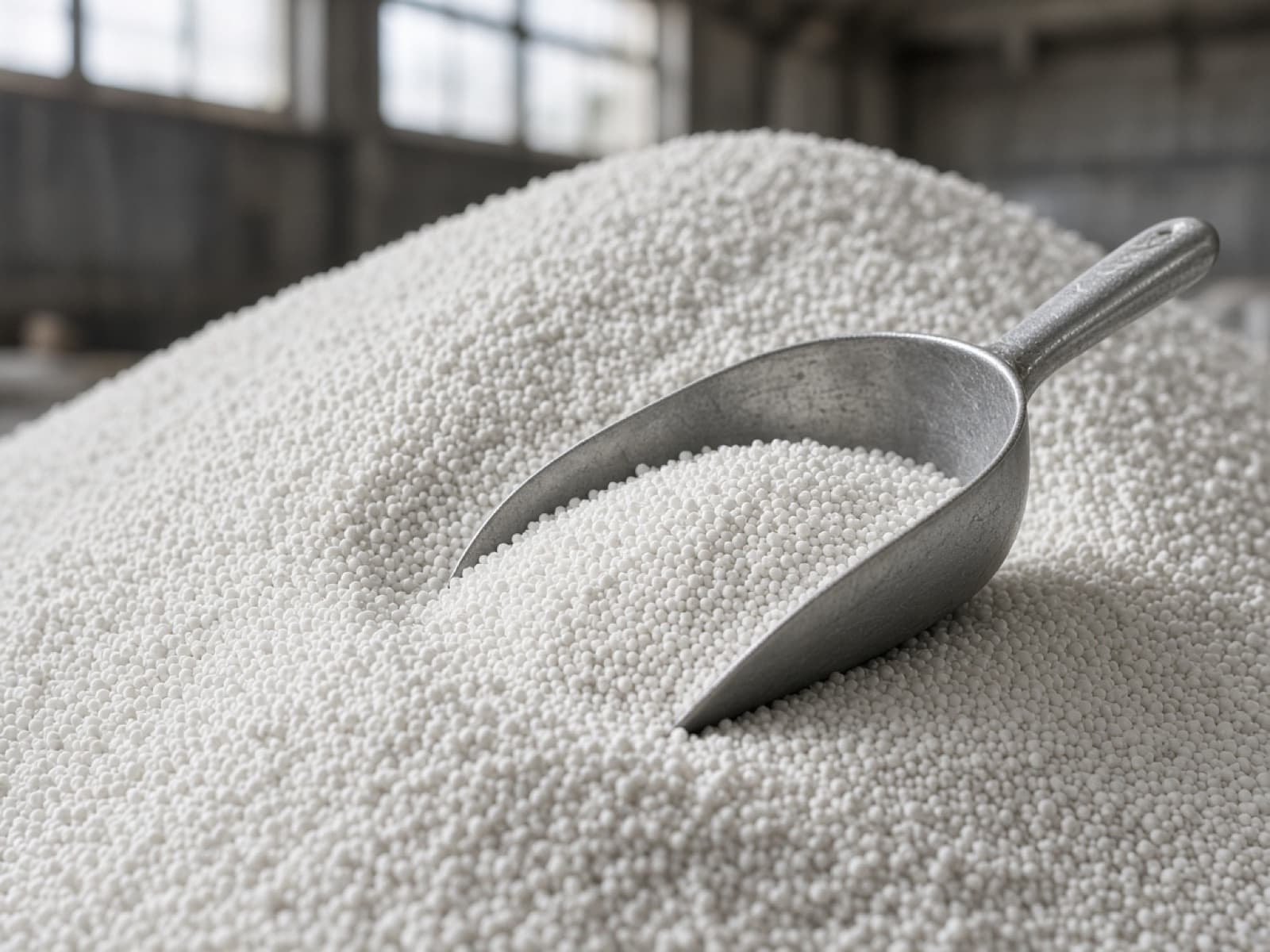
Importers and blenders buying bulk ammonium chloride fertilizer settle four points before contracting: agricultural grade on the RFQ, nitrogen and chloride limits on the COA, moisture-proof packaging, and a clear Incoterm on a weight basis.
What ammonium chloride fertilizer is
Ammonium chloride fertilizer is NH4Cl, a nitrogen salt that also carries chloride. A Japanese industrial chemistry note puts nitrogen at about 25 to 26% and chloride at about 66.2%, and says the fertilizer grade is more often used as compound-fertilizer feedstock than as a straight product alone (BSI Bio Science Institute). Much of the trade supply is a co-product of soda ash manufacture under the combined alkali route known as Hou's process (World Fertilizer). Tuticorin Alkali Chemicals and Fertilizers describes its fertilizer grade as containing 25% N (Tuticorin Alkali / TFL).
Grades and forms
Agricultural vs industrial / technical grade
Agricultural grade is written to fertilizer standards. One exporter's TDS against GB/T 2946-2018 lists total nitrogen (dry basis) at 24.5% minimum, moisture at 3% maximum and sodium as NaCl at 1.2% maximum (Daheng Agro). India's FCO and IS:1114-1964 fertilizer grade, as published by Tuticorin Alkali, call for ammoniacal nitrogen at 25.0% and other chlorides as NaCl at 2.0% maximum, with moisture at 2.0% maximum (Tuticorin Alkali / TFL).
Technical and pure grades are different. The same Indian producer publishes IS:1113-1965 technical and pure grades with NH4Cl at 98.50% and 99.50% for batteries, pharmaceuticals and galvanizing (Tuticorin Alkali / TFL). Write agricultural grade ammonium chloride on every RFQ; reject industrial-only purity offers that lack a fertilizer N guarantee.
Granular vs crystalline / powder
Crystalline or powder material is common from co-product crystallisation. Granular ammonium chloride is usually compacted for bulk blending and compound NP/NPK lines. One granular fertilizer grade sheet lists nitrogen at 25% minimum, moisture at 1% maximum, NaCl at 1.6% maximum, 90% minimum of particles between 2 and 4 mm, and hardness at 25 N minimum (TNN). A sample agricultural grade white granular COA shows nitrogen (dry basis) 25.20% against a 25% minimum, moisture 0.50%, hardness 25 N, and 90% of particles in the 2 to 4 mm band (Star Grace Mining COA). Match granule size to the other blend components to limit segregation.
Where it fits and where it doesn't
Chloride content decides crop fit. Daheng lists rice, wheat, maize and cotton among chloride-tolerant field uses, and flags caution on tobacco, potato, sweet potato and citrus (Daheng Agro). Tuticorin Alkali names paddy, sugarcane, groundnut, banana, coconut, cotton, chillies and mulberry among crops where its fertilizer grade is accepted (Tuticorin Alkali / TFL). The Japanese note lists tobacco, potato, sweet potato, watermelon and melon as crops that dislike chloride (BSI). Lists differ by source; confirm with local agronomy.
Ammonium chloride is physiologically acidic. Dayang describes the fertilizer grade as giving a weakly acid solution in water (Zhejiang Dayang). That acidifying effect is a programme choice, and a risk where soil pH is already low. The trade question is whether chloride and acidification are acceptable at the destination.
Ammonium chloride vs ammonium sulphate vs urea
Blenders compare ammonium chloride vs ammonium sulphate and vs urea when they pick a nitrogen source for a compound grade.
| Product | N form | Companion nutrient | Acidifying effect | Handling notes | Typical use |
|---|---|---|---|---|---|
| Ammonium chloride | Ammoniacal N | Chloride (about 66.2% Cl) | Physiologically acidic | Hygroscopic; keep dry | Chloride-tolerant crops; NP/NPK feedstock |
| Ammonium sulphate | Ammoniacal N | Sulphur (FAO min 23% S) | Acidifying ammonium salt | Moisture and free acidity on COA | N plus fast sulphate S |
| Urea | Amide N | None | Amide N converts to ammonium in soil | Biuret and moisture on COA | High-analysis solid N |
Figures come from cited sources only: chloride share from BSI; ammonium sulphate sulphur and nitrogen floors from FAO purchasing specs (total N minimum 20% dry basis, sulphur minimum 23%); urea total N minimum 46% dry basis from the same FAO list (FAO fertilizer specifications; BSI). A blender stocks agricultural grade ammonium chloride when the programme wants ammoniacal N plus chloride, or when a compound plant needs a chloride-bearing N feedstock. It chooses ammonium sulphate when sulphur is the companion nutrient, and urea when maximum N per kg matters more than a companion anion. See the ammonium sulphate, urea, NPK and ammonium nitrate and CAN guides.
Specs to check on the COA
Ask for a certificate of analysis per lot, tied to the bag marks. Values below come from the sheets and COAs cited. Where none is given, agree a limit with your supplier.
| Parameter | Reference value | Source |
|---|---|---|
| Total N % (dry basis) | 24.5% min (GB/T style); 25% common fertilizer grade | Daheng; Tuticorin Alkali; TNN; Star Grace |
| NH4Cl purity | Ask for NH4Cl % on fertilizer lots; technical grades quote 98.5 to 99.5% NH4Cl | Tuticorin Alkali (tech/pure) |
| Moisture | 1 to 3% max depending on sheet (1% granular TNN/Star Grace; 2% FCO; 3% Daheng) | TNN; Star Grace; Tuticorin; Daheng |
| Sodium chloride (NaCl) | 1.2 to 2.0% max depending on sheet | Daheng; TNN; Tuticorin |
| Sulphate | No fertilizer-grade figure found | Ask for sulphate on the COA |
| Iron | No fertilizer-grade figure found (tech grade lists Fe) | Ask for Fe |
| Heavy metals | Cd 10, As 15, Pb 50 mg/kg max on one ag-grade TDS | Daheng |
| Granule size distribution | 2 to 4 mm, 90% min (granular) | TNN; Star Grace |
| Crushing strength / hardness | 25 N min (granular) | TNN; Star Grace |
Put the ammonium chloride specification on the contract as the standard or the guaranteed N, NaCl and moisture limits, not a trade name alone.
Packaging, shipping and storage
Bulk ammonium chloride ships in 25 kg and 50 kg bags with PE liners, in 1,000 kg jumbo bags, and in bulk where the destination can receive it (Daheng Agro; TNN; Zhejiang Dayang). Dayang lists the product as hygroscopic and tells buyers to keep it away from rain, moisture and sun, and away from alkali and acid chemicals (Zhejiang Dayang). Caking follows moisture uptake, so use lined bags and dry warehouses. Chloride salts can corrode steel equipment when damp; keep conveyors, silos and bagging lines dry. Confirm SDS advice with the supplier before the first shipment.
How bulk ammonium chloride is priced
Ammonium chloride price offers are quoted on a weight basis under an Incoterm such as FOB, CFR or DAP. Drivers include soda ash plant output (fertilizer grade is often a Hou-process co-product), ammonia cost, origin, grade, packaging and freight (World Fertilizer). Compare offers on the same Incoterm and on cost per kg of nitrogen delivered, and confirm every offer is agricultural grade with the same N and NaCl guarantee.
Supplier checks for importers
- Ask whether you are dealing with the producer or a trader, and get the plant name and process route.
- Write agricultural grade ammonium chloride on the RFQ and refuse industrial-only purity quotes.
- Use third-party inspection at loading for weight, sampling and analysis.
- Analyse samples for N, moisture, NaCl and insolubles before contracting, then on arrival.
- Compare COAs across several lots for consistency.
- Agree payment terms that tie release of funds to inspection results.
A supplier that publishes the fertilizer standard (for example GB/T or FCO) with its TDS is easier to hold to a contract than one that only markets "white crystal."
Import compliance
Many countries require fertilizer registration before sale, set labeling rules for nutrient content, and limit heavy metals. Some markets restrict or discourage chloride-based fertilizers for certain crops or zones. Daheng notes that fertilizer-grade ammonium chloride can fall under mandatory export inspection at origin (Daheng Agro). Verify registration, labeling and chloride restrictions with your local regulator and customs broker before the first shipment.
FAQ
What is ammonium chloride fertilizer?
Ammonium chloride fertilizer is NH4Cl, a nitrogen salt that also carries chloride. Trade grades are commonly around 25% N, and much of the supply is a co-product of soda ash manufacture under the Hou combined alkali process. Importers buy it for chloride-tolerant programmes or as feedstock for compound NP and NPK plants.
How much nitrogen does ammonium chloride contain?
Fertilizer grade is commonly about 25% ammoniacal nitrogen. Tuticorin Alkali publishes 25.0% N against FCO and IS:1114-1964, Daheng lists 24.5% N minimum dry basis against GB/T 2946-2018, and TNN and Star Grace use a 25% N minimum. Take the figure from the COA for the lot you receive.
Which crops and markets use it, and which avoid it?
Chloride-tolerant crops such as rice, wheat, maize and cotton appear on supplier lists; Tuticorin also names paddy, coconut, cotton and other field crops. Chloride-sensitive crops commonly flagged include tobacco, potato, sweet potato, citrus, watermelon and melon. Confirm fit with local agronomy, because lists differ by source.
Ammonium chloride vs ammonium sulphate and urea: when does a blender choose it?
A blender chooses ammonium chloride when the grade needs ammoniacal N plus chloride, or when a compound plant wants a chloride-bearing N feedstock. It chooses ammonium sulphate when sulphur is the companion nutrient, and urea when the priority is maximum N per kg without a companion anion.
Buy or sell ammonium chloride on GetFertilizer
Looking for bulk ammonium chloride? Post a buy request with agricultural grade, N and NaCl limits, granule or crystal form, packaging, quantity in kg and Incoterm. Suppliers can list their product in the inorganic fertilizers category.