

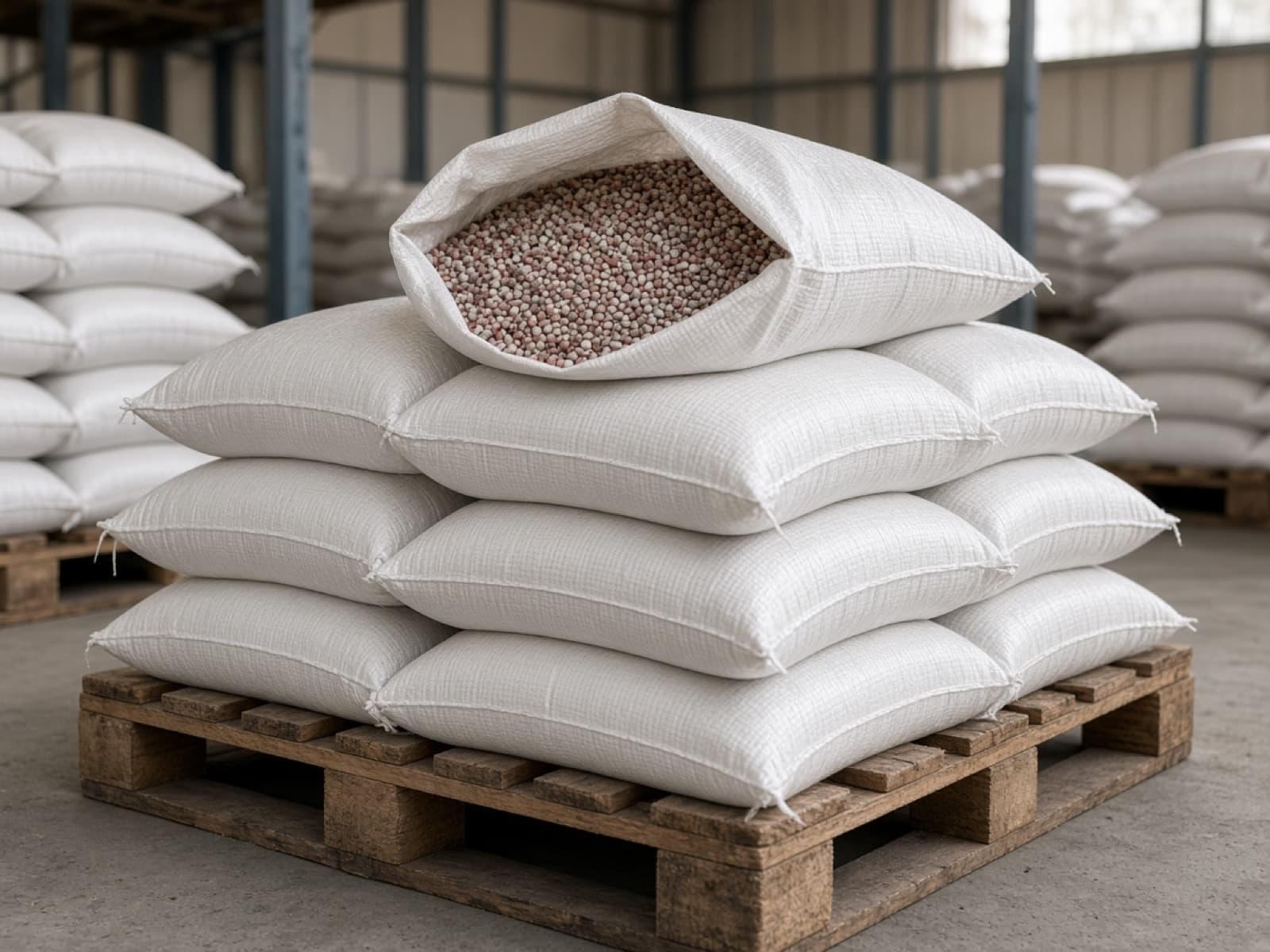
Before you contract for polyhalite fertilizer, fix the nutrient guarantees, the particle-size grade, packing and the documents needed at destination. This guide is for importers, distributors and blenders.
What it is and who buys it
Polyhalite is a naturally occurring hydrated sulphate of potassium, calcium and magnesium. Anglo American gives the mineral formula as K2SO4·MgSO4·2CaSO4·2H2O and describes crushing and granulating the ore. ICL says the fertilizer is produced by mining, crushing and screening, with no chemical separation. The product is sold under trade names such as Polysulphate and POLY4.
Figures vary by grade and producer, so use the current sheet for the cargo. ICL's granular grade guarantees 14% K2O, 48% SO3, 6% MgO and 17% CaO, all water-soluble (19.2% S, 3.6% Mg and 12.2% Ca on an elemental basis). ICL's standard grade guarantees 13% K2O, 46.5% SO3, 5.6% MgO and 16.5% CaO, all water-soluble. A second producer's technical page lists 14% K2O, 48% SO3, 6% MgO and 17% CaO for a granulated product. Importers, distributors and blenders buy it for direct application or for blends. Commercial supply comes from only a few mines.
Grades and particle sizes
Granular
ICL describes its granular grade as 2-4 mm in diameter, and as suitable for straight application, for blends, and for use alongside nitrogen fertilizers. Agree a sieve distribution that matches the other components in your blend, so the mix does not segregate. Put the size range into the contract. The grade name alone is not enough.
Fine or powder
ICL's standard grade is the fine product. The company uses it for direct application and as a raw material in granulated PK and NPK (including NPKS) production, where it can replace filler with K, S, Mg and Ca. For fines going into a granulation plant, agree a screen analysis and dust limits.
Polyhalite vs SOP, MOP and kieserite
Polyhalite, SOP and MOP all supply potassium. They do not deliver the same nutrient package per kg of product. SOP supplies potassium and sulphur and is the usual chloride-free dry potash alternative. MOP is the concentrated potash source and carries chloride. Kieserite supplies magnesium and sulphur. Polyhalite supplies potassium, sulphur, magnesium and calcium in sulphate form, at a lower K2O concentration than SOP or MOP.
More product weight is therefore needed to deliver the same amount of potassium. That extra weight also brings sulphate sulphur plus magnesium and calcium. Those nutrients have value only if they belong in the buyer's formula. Compare offers on a landed value per kg of nutrient, using the COA.
ICL and Anglo American both describe a gradual, prolonged nutrient release from the natural mineral. Treat that as a producer description of release behaviour. It does not replace your own checks. Those pages describe chloride as low, but the sheets fetched here do not state a numerical maximum. Write a limit into the contract if chloride-sensitive blends depend on it. See our potash (MOP and SOP) and kieserite guides.
How bulk polyhalite is priced
Quote basis
The polyhalite price is quoted on a weight basis under an Incoterm such as FOB, CFR or CIF, with a named port. State whether the offer is for loose bulk or bagged material. Identify bag type, net fill and whether packing and inspection are inside the quote.
Nutrient-value comparison
Grades differ in K2O, SO3, MgO and CaO. Convert competing offers to a landed value per kg of the nutrient you are actually buying, using the COA guarantees and the same Incoterm and packing.
What moves the offer
Limited mine supply, freight and season can move availability and the offer. Freight can be a large share of landed cost, because the product is less concentrated in potassium than SOP or MOP.
COA and specification checks
Require a lot COA with methods and results. A product brochure is not enough. Agree whose analysis is final and how retained samples are kept.
| Parameter | Why it matters | Where to verify |
|---|---|---|
| K2O | Sets the potash guarantee | Lot COA vs the contract |
| SO3 / S | Sets the sulphur guarantee | Lot COA vs the contract |
| MgO | Sets the magnesium guarantee | Lot COA vs the contract |
| CaO | Sets the calcium guarantee | Lot COA vs the contract |
| Chloride | Needed for chloride-sensitive blends and labels | Lot result; no numerical maximum on the producer sheets fetched here |
| Moisture | Affects caking, dust and handling | Lot result and an agreed maximum |
| Particle size distribution | Checks blend compatibility and spreading | Agreed sieve analysis; ICL granular is 2-4 mm |
| Insolubles | Relevant if the material will be processed or dissolved | Lot result if needed for your process |
| Heavy metals including cadmium | Destination compliance | Accredited lab report against the market's limits |
Compliance and import documents
For CE-marked EU fertilising products, Regulation (EU) 2019/1009, Annex I, PFC 1(C)(I) sets contaminant limits. For inorganic macronutrient fertilizers with less than 5% P2O5-equivalent by mass, the cadmium ceiling is 0.000003 kg/kg dry matter. Lead is 0.000120 kg/kg dry matter and mercury is 0.000001 kg/kg dry matter. The grades above contain no declared phosphate, so that cadmium line applies in this category. Figures are converted to kg from the regulation's published units and apply only in this legal category. Products that are not CE marked may follow a national fertilizer route instead.
OMRI lists named ICL grades (Granular, Standard and Premium) as allowed crop fertilizers under the NOP and COR programmes, in the mined minerals category (for example Granular icf-13795 / icf-13796). The listing is product-specific and time-limited. Ask for the current certificate that matches the brand, grade and destination standard. A polyhalite cargo is not automatically approved for organic use.
Ask your broker for the COA, certificate of origin, invoice, packing list, transport document and SDS, plus registration or import permits where required. Request a phytosanitary certificate only if the destination requires it. An Anglo American SDS for its granulated product states that the material is not classified for transport under ADR, IMDG, IATA, ADN and RID.
Packing, shipping and storage
An ICL product page states that the fertilizer is sold in 25 kg bags and big bags. Confirm the big-bag net fill, and whether 50 kg bags, 1,000 kg bags or loose bulk vessel loading are available, on the current offer.
ICL's handling notes say to store the product under dry conditions and to seal partly used or damaged bags. The Anglo American SDS requires storage in a well-ventilated place, kept cool. Keep bags off wet floors, control dust, and agree a rejection rule for wet or caked cargo.
Supplier checks
Because supply comes from only a few mines, ask whether the supplier is the producer, an authorised distributor or a trader. Require traceability to the producing mine and plant. Compare recent lot COAs with the offered nutrient and size guarantees. Book independent inspection and sampling at loading, including packing, weight and a particle-size test if the cargo is for blending. Tie payment to those documents, and to remedies for off-spec analysis, wet bags or the wrong size fraction.
FAQ
What nutrients does polyhalite supply?
It is a mined hydrated sulphate of potassium, sulphur, magnesium and calcium. Confirm the K2O, SO3, MgO and CaO minima on the current producer sheet for that grade.
Is polyhalite chemically processed?
ICL says it is mined, crushed and screened, with no chemical separation. Anglo American describes crushing and granulating the ore.
How should buyers compare polyhalite with SOP or kieserite?
Compare landed value per kg of the nutrients you actually need, under the same Incoterm and packing. Polyhalite carries K, S, Mg and Ca at a lower K2O concentration than SOP; kieserite supplies magnesium and sulphur.
Is polyhalite approved for organic farming?
Some branded products are. OMRI lists named ICL grades as allowed under NOP and COR. Ask for the current certificate that matches the cargo and destination standard.
Source polyhalite on GetFertilizer
Post a polyhalite request on GetFertilizer quote listings with grade, particle size, quantity in kg, packing and Incoterm. Browse inorganic fertilizer listings to compare offers. For compound blends, see the NPK guide.